
LAGOS, Nigeria (AP) — Trumpets and car horns sound first, then local gang members rush by screaming and chugging cheap liquor as a convoy of campaign vehicles push through the crowded streets of Nigeria's main city carrying local candidates asking to represent the people in a system rife with corruption.
Races to run Nigeria's 774 local governments represent politics at its rotten core in the oil-rich nation, where crude sales prop up politicians and the neighborhood councils become their personal fiefdoms. Those living in the megacity of Lagos voted Saturday for their local representatives, but the results appeared to be a foregone conclusion as political fortunes are made and lost based on personality and muscle in Africa's most populous nation.
"I know they will change, (but) there's nothing we can do if they don't change," said B.G. Said, a 62-year-old voter who waited at a polling place that opened two-and-a-half hours late Saturday.
Nigeria inherited local governments from British colonialists and kept the system in place after gaining independence in 1960. Little changed under Nigeria's military dictatorships and when democracy took hold in 1999. The governments, run by council members and overseen by a chairman, remain responsible for road maintenance, sewage systems and markets, as well as assisting in health care and education in their areas.
Yet even on Ikoyi Island in Lagos, which once housed the nation's federal government, potholed roads with little asphalt run past some of the most expensive real estate in all of Africa. Public schools remain dilapidated and overcrowded. Passers-by relieve themselves in open drains.
Area chairman Wale Adeniji, running for re-election under Lagos' ruling Action Congress of Nigeria, said his administration worked hard in its last three-year term. However, when interviewed this week by The Associated Press, Adeniji struggled to offer any specific improvements completed by his administration. He also repeatedly declined to say how much money his area received from the state as part of the federal funds allocated to local governments.
Still, as he campaigned and met with the public, no one asked him specific questions. Many surrounded him chanting the party's acronym ACN, and youths offered shouts of "Well done, sir!"
Adeniji is one of the "Big Men," the "oga" in the local language, smiling amid the squalor and broken streets, asking once again to represent a people who long ago gave up on the government.
At a crowded local market near an army barracks, Adeniji made no promises of improving services when speaking to elders there. His entourage passed out gift bags filled with notebooks and unmarked boxes. Others received shirts and caps bearing his image.
"We will vote for ACN this Saturday," market leader Jokotade Logun Tairat promised after hearing Adeniji describe the voting process in her sweltering, dark office.
But she hinted at the tit-for-tat politics of the country: "We are like Oliver Twist: we keep asking for more. Please don't forget us."
Such exchanges, whether monetary or for favors later, remain common in local politics, said Foluso Idumu, the program coordinator for the Orderly Society Trust, which advocates for better governance in Nigeria.
State-level officials put trusted lieutenants or lackeys into local governments, who tailor their opinions and operations to suit their political "godfathers," Idumu said. Those who don't obey lose out on unmonitored government money, while those who follow orders end up with SUVs, she said.
Idumu's organization had to abandon a grant-funded effort to honor innovative local government leaders when a survey of more than 70 areas found no one worthy of the award.
"It's a national malaise, really," Idumu said. "We really still don't have democratic principles being adhered to and followed duly."
Opposition candidates, even for the nationally dominant People's Democratic Party, rarely campaign for office in ACN-dominated Lagos. On Ikoyi Island, the national party's candidate Ibrahim Babajide Obanikoro bucked the trend, campaigning one day with a host of buses, cars and motorcycles following him.
At one stop, many young, unemployed men known as "area boy" gang members drank from bottles of local liquor and jostled in close enough to touch the candidate.
"As you can see, I'm a man of the people," Obanikoro told the AP. "They have access to me and all the time they have my back."
Some of those men in the crowd attended Adeniji's campaign the day before.
On Saturday, voters waited on one rubbish strewn dirt road in Lagos Island, the commercial hub of the city, waiting to vote amid water-filled potholes. Nearly all said they voted for ACN and seemed content with the party.
"ACN is doing this democracy well well," said Risikat Jinadu, 63. "They are trying."
Many support the party for its most prominent politician, Lagos state Gov. Babatunde Raji Fashola, who they say is responsible for many of the improvements seen in the once crime-ridden city. Yet Fashola himself cast his ballot Saturday in front of a worn grammar school in his Surulere neighborhood, where daylight peeked through holes in the ceiling and worn wooden benches sat among litter on the cement floors.
Asked about local leaders being unable to even say how much government money they receive, Fashola told the AP: "That's no reason to make the conclusion he has 'chopped' the money, if he couldn't tell you why."
Still, the run-up to Saturday's election remains likely the only contact many in the Lagos public will have with their local leaders. Surveys by the Orderly Society Trust suggest more than half of the nation can name at the most one or two of those leaders, if any at all.
Sunday, October 23, 2011


Up to 5,000 tyres found in Menai Bridge illegal dump
BBC
Between 3,000 and 5,000 tyres have been discovered being stored illegally on Anglesey.
The Environment Agency raided the dump in Menai Bridge and also executed a search warrant at an address in Llangefni.
Officials said the tyres were being stored and sorted at Menai Bridge before being exported to Ghana.
The agency said an enforcement notice would order the tyres removal.
It said North Wales Police were also involved in the raids and it was liaising with the council planning enforcement team.
Disposal cost
The agency's Environmental Crime Team leader Jason Westerberg-Liptrot said illegal sites were a hazard.
"Operators who run sites illegally put the environment and human health at risk and undermine legitimate businesses," he said.
"The cost of disposal of a car tyre is in the region of £1.44 per tyre and if anyone offers to take waste tyres away for less they should be treated with suspicion," he continued.
The agency said landlords and agents should always check with its officials before letting out property to companies who deal in waste.
Between 3,000 and 5,000 tyres have been discovered being stored illegally on Anglesey.
The Environment Agency raided the dump in Menai Bridge and also executed a search warrant at an address in Llangefni.
Officials said the tyres were being stored and sorted at Menai Bridge before being exported to Ghana.
The agency said an enforcement notice would order the tyres removal.
It said North Wales Police were also involved in the raids and it was liaising with the council planning enforcement team.
Disposal cost
The agency's Environmental Crime Team leader Jason Westerberg-Liptrot said illegal sites were a hazard.
"Operators who run sites illegally put the environment and human health at risk and undermine legitimate businesses," he said.
"The cost of disposal of a car tyre is in the region of £1.44 per tyre and if anyone offers to take waste tyres away for less they should be treated with suspicion," he continued.
The agency said landlords and agents should always check with its officials before letting out property to companies who deal in waste.
Saturday, October 22, 2011
Ghana to regulate space research: official
CAPE TOWN (Xinhua) -- Ghana wants to draft laws to regulate its infant space science industry, Hanidu Ada-Kurugu, the deputy director of human resources in Ghana’s Ministry of Environment, Science and Technology, said here on Monday.
“Creating laws to regulate the development of the industry is important ... That would be critical for us to see positive results,” he told a United Nations satellite workshop taking place in Cape Town, on the sidelines of the 62nd International Astronautical Congress (IAC).
Satellite science would help the country’s socioeconomic progress, Ada-Kurugu said.
Meanwhile, Nana Ansah Adoo, Ghana’s top satellite researcher, said Ghana is in the process of “seeking guidance and experts to formulate a policy on space science.”
Adoo, based with the one-year-old Ghana Space Science and Technology Center (GSSTC), is one of many delegates from the developing world who are taking advantage of the conference to learn how to use satellite technology to overcome problems of poverty in remote regions.
“It is one of the reasons that I came to this conference: to share ideas, interact and make connections that could help space science in Ghana to grow,” he said.
Ghana is working with South African scientists to convert a dormant communications satellite into a radio astronomy telescope at the Nkuntunse earth station on the outskirts of Accra, official sources said.
With help from astronomers from the Square Kilometer Array (SKA) radio telescope bid team, Ghana hopes to resuscitate the equipment.
Ghana will host one of the SKA radio telescopes if South Africa beats Australia in the race to host the huge project. The announcement is expected in February 2012.
The AIC opened in the Cape Town Convention Center earlier in the day, with the theme of African Astronaissance. The five-day conference is the first being held on the African Continent, a move seen as a boost to African astronautical research.
“It is the first time we hold our Congress in Africa,” said Berndt Feuerbacher, president of the International Astronautical Federation (IAF).
“I think this is a very important step, and I am particularly grateful to our host country for helping us to make this Congress a true African event, involving the whole continent. “
The conference is attended by hundreds of representatives and senior executives of the world’s space agencies along with academics, researchers, industry and commerce executives, students and young professionals. it will last until Oct. 7, a period chosen to coincide with World Space Week, organizers said.
The IAC, which is organized by IAF, the International Academy of Astronautics (IAA), and the International Institute of Space Law (IISL), is the largest space-related conference world-wide and selects an average of 1,000 scientific papers every year.
The IAF, together with the IAC and the IISL, holds the IAC every year, an annual meeting of the actors in the discipline of space and consists of plenary sessions, lectures and meetings, in addition to a large exhibition running concurrently.
“This is a very special Congress, as for the first time the IAC comes to Africa, and the Federation celebrates its 60th anniversary here. Alongside the public and technical programs, a comprehensive exhibition will be embedded within the Congress. Once again, this features the highly successful Cluster forum, facilitating the cooperation between small and large enterprises, with a special focus on Africa,” Feuerbacher said.
On the sidelines of the congress, members of Parliament from all continents will also gather in Cape Town to discuss how space can help human and environmental security, according to Feuerbacher.
“For those just starting in our industry, we offer student and young professionals programs and again we will sponsor young individuals to attend the IAC with the IAF Youth Grants initiative, engaging in exchanges of ideas with our senior experts,” he said.
. ..
“Creating laws to regulate the development of the industry is important ... That would be critical for us to see positive results,” he told a United Nations satellite workshop taking place in Cape Town, on the sidelines of the 62nd International Astronautical Congress (IAC).
Satellite science would help the country’s socioeconomic progress, Ada-Kurugu said.
Meanwhile, Nana Ansah Adoo, Ghana’s top satellite researcher, said Ghana is in the process of “seeking guidance and experts to formulate a policy on space science.”
Adoo, based with the one-year-old Ghana Space Science and Technology Center (GSSTC), is one of many delegates from the developing world who are taking advantage of the conference to learn how to use satellite technology to overcome problems of poverty in remote regions.
“It is one of the reasons that I came to this conference: to share ideas, interact and make connections that could help space science in Ghana to grow,” he said.
Ghana is working with South African scientists to convert a dormant communications satellite into a radio astronomy telescope at the Nkuntunse earth station on the outskirts of Accra, official sources said.
With help from astronomers from the Square Kilometer Array (SKA) radio telescope bid team, Ghana hopes to resuscitate the equipment.
Ghana will host one of the SKA radio telescopes if South Africa beats Australia in the race to host the huge project. The announcement is expected in February 2012.
The AIC opened in the Cape Town Convention Center earlier in the day, with the theme of African Astronaissance. The five-day conference is the first being held on the African Continent, a move seen as a boost to African astronautical research.
“It is the first time we hold our Congress in Africa,” said Berndt Feuerbacher, president of the International Astronautical Federation (IAF).
“I think this is a very important step, and I am particularly grateful to our host country for helping us to make this Congress a true African event, involving the whole continent. “
The conference is attended by hundreds of representatives and senior executives of the world’s space agencies along with academics, researchers, industry and commerce executives, students and young professionals. it will last until Oct. 7, a period chosen to coincide with World Space Week, organizers said.
The IAC, which is organized by IAF, the International Academy of Astronautics (IAA), and the International Institute of Space Law (IISL), is the largest space-related conference world-wide and selects an average of 1,000 scientific papers every year.
The IAF, together with the IAC and the IISL, holds the IAC every year, an annual meeting of the actors in the discipline of space and consists of plenary sessions, lectures and meetings, in addition to a large exhibition running concurrently.
“This is a very special Congress, as for the first time the IAC comes to Africa, and the Federation celebrates its 60th anniversary here. Alongside the public and technical programs, a comprehensive exhibition will be embedded within the Congress. Once again, this features the highly successful Cluster forum, facilitating the cooperation between small and large enterprises, with a special focus on Africa,” Feuerbacher said.
On the sidelines of the congress, members of Parliament from all continents will also gather in Cape Town to discuss how space can help human and environmental security, according to Feuerbacher.
“For those just starting in our industry, we offer student and young professionals programs and again we will sponsor young individuals to attend the IAC with the IAF Youth Grants initiative, engaging in exchanges of ideas with our senior experts,” he said.
. ..
Kadafi had a 'staggering' $200 billion stashed around the world

REPORTING FROM WASHINGTON -- Moammar Kadafi secretly salted away more than $200 billion in bank accounts, real estate and corporate investments around the world before he was killed, about $30,000 for every Libyan citizen and double the amount that Western governments previously had suspected, according to senior Libyan officials.
The new estimates of the deposed dictator’s hidden cash, gold reserves and investments are “staggering,” one person who has studied detailed records of the asset search said Friday. “No one truly appreciated the scope of it.”
If the values prove accurate, Kadafi will go down in history as one of the most rapacious as well as one of the most bizarre world leaders, on a scale with the late Mobutu Sese Seko in the Democratic Republic of Congo or the late Ferdinand Marcos in the Philippines.
Revelation of the stunning size of the portfolio may stir anger among Libyans -- about one-third of whom live in poverty. And it is likely to spur an effort to return the money to Libya’s transitional government, which says it wants to embark on ambitious plan to modernize the country after nearly 42 years of rule by Kadafi’s whim.
During his 42 years in power, Kadafi steered aid and investments to benefit his own family and tribe, but he denied support for much of the country, especially the eastern region that historically resisted his family’s despotic grip on power.
Kadafi’s death after he was captured by revolutionary fighters Thursday outside his birthplace, the coastal town of Surt, not only ended the armed uprising that erupted last February, it also sets the stage for other governments to begin repatriating a bonanza in sequestered assets to the oil-rich but cash-poor nation.
Obama administration officials were stunned last spring when they found $37 billion in Libyan regime accounts and investments in the United States, and they quickly froze the assets before Kadafi or his aides could move them.
Governments in France, Italy, England and Germany seized control of another $30 billion or so. Investigators estimated that Kadafi had stashed perhaps another $30 billion elsewhere in the world, for a total of about $100 billion.
But subsequent investigations by American, European and Libyan authorities determined that Kadafi secretly sent tens of billions more abroad over the years and made sometimes lucrative investments in nearly every major country, including much of the Middle East and Southeast Asia, officials said Wednesday.
Most of the money was under the name of government institutions such as the Central Bank of Libya, the Libyan Investment Authority, the Libyan Foreign Bank, the Libyan National Oil Corp. and the Libya Africa Investment Portfolio.
But investigators said Kadafi and his family members could have had access to any of the money if they chose to.
Libya has the largest proven oil reserves in Africa.
UN commends Ghana for peaceful conflict prevention mechanisms
Accra , GNA - The United Nations (UN) on Friday commended Ghana for developing mechanisms that ensured peaceful resolution of disputes, citing the country’s National Architecture for Peace as a “sterling” model to the global community on conflict settlement.
It said achievements of the UN in political mediations had been made possible as a result of support from member states like Ghana, which had consistently contributed to the global goal of mediation as a means for peacefully settling disputes.
"The resulting national capacity for peaceful relations across differences underpins the optimism that Ghana is well on the road to improve levels of human development,”Ruby Sandhu-Rojon, UN Resident Coordinator in Ghana said at a press briefing on the 66th UN Day celebrations in Accra.
“The UN commits to further support the country’s peace initiatives,” she added.
The 66th UN Day which falls on Monday, October 24, would witness Ghana joining the rest of the world to observe the Day, geared towards emphasizing preventive measures to conflict resolution.
Ghana is to celebrate the Day, which marks anniversary of the entry into force in 1945 of the UN Charter, with a week-long series of events aimed at reflecting on issues of global concern and to bring workings of the UN closer to the people.
This year's event on the theme: “The Role of Mediation in the Settlement of Disputes by Peaceful Means” would improve understanding on the importance of mediation as a panacea to peaceful resolution of disputes.
Activities to mark the Day include “What do you know” quiz programme, Talking Point on Ghana Television, a Model UN Session by schools, a flag raising ceremony, adult education programmes in various dialects across the country.
In addition, the UN would visit some schools in Greater Accra, Volta and Central regions to engage students on the UN’s role and mandate, and commitments by world leaders to alleviate poverty.
Alhaji Mohammad Mumuni, Minister of Foreign Affairs and Regional Integration in an address read for him described this year's theme of the celebration as timely because the UN Charter enjoined member states to settle disputes by peaceful means.
He noted that despite occasional setbacks, mediation had also proven to be the most cost-efficient instrument for settlement of disputes, adding that the peaceful resolution of disputes was a sovereign responsibility of any State.
The Sector Minister said Ghana in keeping with the responsibility of settling disputes peacefully, had taken the needed steps by establishing important bodies to deal with conflict situations in the country.
In addition, Ghana in keeping with international law, treaty obligations and the settlements of disputes by peaceful means, would continuously explore avenues for peaceful; mediation of conflicts both internally and in the sub-region.
GNA
It said achievements of the UN in political mediations had been made possible as a result of support from member states like Ghana, which had consistently contributed to the global goal of mediation as a means for peacefully settling disputes.
"The resulting national capacity for peaceful relations across differences underpins the optimism that Ghana is well on the road to improve levels of human development,”Ruby Sandhu-Rojon, UN Resident Coordinator in Ghana said at a press briefing on the 66th UN Day celebrations in Accra.
“The UN commits to further support the country’s peace initiatives,” she added.
The 66th UN Day which falls on Monday, October 24, would witness Ghana joining the rest of the world to observe the Day, geared towards emphasizing preventive measures to conflict resolution.
Ghana is to celebrate the Day, which marks anniversary of the entry into force in 1945 of the UN Charter, with a week-long series of events aimed at reflecting on issues of global concern and to bring workings of the UN closer to the people.
This year's event on the theme: “The Role of Mediation in the Settlement of Disputes by Peaceful Means” would improve understanding on the importance of mediation as a panacea to peaceful resolution of disputes.
Activities to mark the Day include “What do you know” quiz programme, Talking Point on Ghana Television, a Model UN Session by schools, a flag raising ceremony, adult education programmes in various dialects across the country.
In addition, the UN would visit some schools in Greater Accra, Volta and Central regions to engage students on the UN’s role and mandate, and commitments by world leaders to alleviate poverty.
Alhaji Mohammad Mumuni, Minister of Foreign Affairs and Regional Integration in an address read for him described this year's theme of the celebration as timely because the UN Charter enjoined member states to settle disputes by peaceful means.
He noted that despite occasional setbacks, mediation had also proven to be the most cost-efficient instrument for settlement of disputes, adding that the peaceful resolution of disputes was a sovereign responsibility of any State.
The Sector Minister said Ghana in keeping with the responsibility of settling disputes peacefully, had taken the needed steps by establishing important bodies to deal with conflict situations in the country.
In addition, Ghana in keeping with international law, treaty obligations and the settlements of disputes by peaceful means, would continuously explore avenues for peaceful; mediation of conflicts both internally and in the sub-region.
GNA
Apollo 11 on the increase in Upper East

Bolgatanga, GNA – There is upsurge of Haemalistic Conjunctivitis infection, commonly referred to as “Apollo 11,” in the Upper East Region.
The condition, which is an infection of the eye, causes irritation in and outside the eye thereby bringing discomfort to infected persons. It also causes redness of the eye and sensitivity to light.
Mr Moro Sanda Issahaku, an Ophthalmic nurse at the Bolgatanga Regional Hospital, who spoke to the Ghana News Agency, said the outbreak of Apollo 11 started about two months ago with the hospital recording between 40 and 55 cases daily.
Mr Issahaku said the condition, which is caused by viruses, could lead to serious cornea ulcerations which have the potential to develop into blindness if not treated.
He said treatment given to patients with acute haemalistic conjunctivitis helps to reduce eye related complications but does not necessarily cure the disease.
The disease is spread through contact with an infected person, he said, explaining infected persons could spread it through sneezing without covering their mouths, robbing their hands with their eyes and touching or shaking the hands of others without washing them.
He advised victims to observe personal hygiene by washing their hands constantly with soap.
To avoid the spread of the disease in schools and workplaces he advised people who have the condition to stay away and ensure a proper treatment of the condition.
GNA
Deformed children are being killed in Ghana
A GNA Feature
By Albert Oppong-Ansah
Tamale, Oct. 14, GNA - Three-year old John the Baptist, who hails from Gnani, a community in the Yendi Municipality of the Northern Region, was born with a vein defect.
At the age of two, John’s parents wrapped him in white cloths and left him beside a public refuse dump. His condition was bad because his neck and legs were fragile and could neither sit nor stand due to the vein defect.
John’s situation was not different from four-year old Makpato whose parents decided to kill her due to her inability to talk at the age of three.
What John and Makpato passed through is unfortunately the ordeal many children who are born with defects are subjected to in communities such as Saboba, Wodando, Zabzugu, Tatale and Bimbilla.
The common belief among some communities in the North is that children born with deformities are “spirit children” who are evil or a taboo to be sheltered and catered for.
A painstaking information gathered by the Ghana News Agency (GNA) indicates that such babies have distinguished features like, beard, pubic hair, double sex organs (hermaphrodites), protruding eyes, abnormally large head or inability to talk and walk after they hit three to six years.
Other children who bear societal stigma are those who constantly bite their mother’s breast during breast feeding, are born during famine or whose mothers die during delivery.
It is alleged that most of these children are killed or abandoned to their fate. In some instances, poisonous concoctions are forced down their throat after which, they are abandoned in a grove or forest to die.
The parents and relatives of these children have no say with regards to the killing of these children because it is a communal belief which needed to be complied with.
Asked about the cause of such deformities, Dr Anthony Amankwah Amponsem, Paediatric Consultant at Tamale Teaching Hospital said genetic factors, congenital maternal disease and infections, age of a mother, radiation as well as social habits like alcoholism could affect the development of a fertilised ovum.
Most the deformities occur during the first three months of the pregnancy during which most of the body organs are formed.
Birth defects could happen even if partners have no such history in their families or had given birth to healthy children in the past.
These defects, Dr Amponsah said could be prevented while some could be corrected if spotted early.
At the turn of the century, Ghana, along with 189 UN member countries adopted the Millennium Declaration that laid out the vision for a world of common values and renewed determination to achieve peace and decent standards of living for every man, woman and child.
Our nation was the first West Africa country that rectified the United Nations Convention on the Rights of the Child, which was adopted and opened for signature, ratification and accession by General Assembly resolution 44/25 of 20 November 1989 with article 49.
Article 23 clause one, the convention mandates States Parties to recognise that a mentally or physically disabled child should enjoy a full and decent life, in conditions which ensure dignity, promote self-reliance and facilitate the child's active participation in the community.
The clause two states that, “States Parties recognise the right of the disabled child to special care and shall encourage and ensure the extension, subject to available resources, to the eligible child and those responsible for his or her care, of assistance for which application is made and which is appropriate to the child's condition and to the circumstances of the parents or others caring for the child”.
The third paragraph also explained that “Recognising the special needs of a disabled child, assistance extended in accordance with paragraph 2 of the present article shall be provided free of charge, whenever possible, taking into account the financial resources of the parents or others caring for the child, and shall be designed to ensure that the disabled child has effective access to and receives education, training, health care services, rehabilitation services, preparation for employment and recreation opportunities in a manner conducive to the child's achieving the fullest possible social integration and individual development, including his or her cultural and spiritual development .
On the national front the Sub-Part I – Rights of the child and parental duty of Ghana’s Children’s Act 1998 Act 560 enacted by Parliament spells out how a disabled child should be treated by the parent or care takers.
The section 10 clause (1) and (2) says: “No person shall treat a disabled child in an undignified manner. A disabled child has a right to special care, education and training wherever possible to develop his maximum potential and be self-reliant.”
The punishment for offenders of the regulation is that, “Any person who contravenes a provision of this Sub-Part commits an offence and is liable on summary conviction to a fine not exceeding GH¢5 million or to a term of imprisonment not exceeding one year or both.”
A study conducted by the GNA indicates that these laws are either not adhered to or implementation is weak.
Interaction with the parents of one of the deformed victims at Wodando, a community close to Wapuli in the Chereponi District with the GNA revealed widespread belief in the long held tradition that if a “ spirit child” is not killed the entire village would suffer a curse.
This custom emboldens parents to harm their deformed children, says Rev. Fr Cletus Akosah who runs a charity for rescued children.
A girl who was the 13th child of her parents could not alter a word when she was growing up compelling her mother to seek both medical and traditional means to deal with the situation.
“When I took her to Wapuli clinic the doctor who diagnosed her said she has frenulum between her tongue and the floor of her lower jaw, which hinder her speech. This has to be removed before she can speak.
“The doctor said my child is normal. There is nothing wrong with her,” she said.
She said after all efforts have been made to cure her child had failed, people were claiming that they see her in their dreams trying to harm them.
“I had to yield to the community’s tradition that my child is a spirit child and need to be killed or else my family would be banished from the community.”
Rev. Fr. Peter Jabaab Aoyaja of the Gnanie, Good Shepherd Rectorate, told the GNA that he had often threatened people who wanted to kill these children with police arrest.
Within six weeks he was able to rescue about four children from his area saying, “It is becoming alarming. The issue of killing children with defect is serious; government should partner religious bodies and non-governmental organisations to curtail these practices as early as possible”.
Mr John Ankrah Regional Director of the Department of Social Welfare, in an interview with the GNA described the issue as child molestation and right denial.
“This is the first time am hearing of this issue and is not good in this 21st century. Even if children are deformed, they have the right to live.”
He said his outfit would source funding to embark on social education in the various communities, adding “my office does not even have a vehicle to go to the field”.
Mr Abdul-Razak Alhassan, Acting Regional Director of the Department of Child, reiterated that it is a criminal offence under the Child Act 560 and the UN Convention on Right of a Child for a parent, persons or group of persons to kill a child with defects in the name of beliefs and practices.
He called for synergy between the Domestic Violence and Victims Support Unit (DOVVSU) of the Ghana Police Service, Department of Social Welfare, Department of Community Development and Department of Children that have the oversight responsibility of child protection to work effectively.
With regards to child’s growth and behaviour, Mr Alhassan Mustapha, a Psychology lecturer, at the Medical School of the University of Development Studies told GNA that children who have deformities could exhibit signs of aggressiveness and may hate their parents and strangers as they grow.
“This is because the communal bond with the family was cut off from such people throughout their life.”
About 30 of the social outcasts have been rescued and temporarily housed by one Rev. Sr. Stan Therese Mario Mumuni, at Sang, 70 miles from the Regional capital, Tamale.
She told GNA that, unfortunately, the home was almost full to capacity and there is little hope that many more children may be accommodated in the foreseeable future.
“The children are brought almost every two to four weeks”. I think no child must die because of crude custom but must live for Christ,” she said.
Chief Inspector Ebenezer Preprah, in-charge of DOVVSU in Yendi told GNA in an interview that the act of killing deformed children is a serious offence under the section 46 of the criminal code, which constitutes murder.
He said a person or any group of persons who flout this law commit a criminal offence punishable by death.
“We have not had any official report yet and if we do an arrest will be affected,” he warned.
Worldwide, physically challenge persons such as Miss Jessica Cox, a pilot and world acclaimed motivational speaker, Mr Ivor Kobbina Greenstreet, of the Convention People’s Party, had excelled in their fields of endeavour and continue to make meaningful contribution in their countries.
Should the authorities therefore look on as talented children are killed because they are deformed or in the name of traditional believes?
God has a plan for everyone in this world and every human being counts.
GNA
By Albert Oppong-Ansah
Tamale, Oct. 14, GNA - Three-year old John the Baptist, who hails from Gnani, a community in the Yendi Municipality of the Northern Region, was born with a vein defect.
At the age of two, John’s parents wrapped him in white cloths and left him beside a public refuse dump. His condition was bad because his neck and legs were fragile and could neither sit nor stand due to the vein defect.
John’s situation was not different from four-year old Makpato whose parents decided to kill her due to her inability to talk at the age of three.
What John and Makpato passed through is unfortunately the ordeal many children who are born with defects are subjected to in communities such as Saboba, Wodando, Zabzugu, Tatale and Bimbilla.
The common belief among some communities in the North is that children born with deformities are “spirit children” who are evil or a taboo to be sheltered and catered for.
A painstaking information gathered by the Ghana News Agency (GNA) indicates that such babies have distinguished features like, beard, pubic hair, double sex organs (hermaphrodites), protruding eyes, abnormally large head or inability to talk and walk after they hit three to six years.
Other children who bear societal stigma are those who constantly bite their mother’s breast during breast feeding, are born during famine or whose mothers die during delivery.
It is alleged that most of these children are killed or abandoned to their fate. In some instances, poisonous concoctions are forced down their throat after which, they are abandoned in a grove or forest to die.
The parents and relatives of these children have no say with regards to the killing of these children because it is a communal belief which needed to be complied with.
Asked about the cause of such deformities, Dr Anthony Amankwah Amponsem, Paediatric Consultant at Tamale Teaching Hospital said genetic factors, congenital maternal disease and infections, age of a mother, radiation as well as social habits like alcoholism could affect the development of a fertilised ovum.
Most the deformities occur during the first three months of the pregnancy during which most of the body organs are formed.
Birth defects could happen even if partners have no such history in their families or had given birth to healthy children in the past.
These defects, Dr Amponsah said could be prevented while some could be corrected if spotted early.
At the turn of the century, Ghana, along with 189 UN member countries adopted the Millennium Declaration that laid out the vision for a world of common values and renewed determination to achieve peace and decent standards of living for every man, woman and child.
Our nation was the first West Africa country that rectified the United Nations Convention on the Rights of the Child, which was adopted and opened for signature, ratification and accession by General Assembly resolution 44/25 of 20 November 1989 with article 49.
Article 23 clause one, the convention mandates States Parties to recognise that a mentally or physically disabled child should enjoy a full and decent life, in conditions which ensure dignity, promote self-reliance and facilitate the child's active participation in the community.
The clause two states that, “States Parties recognise the right of the disabled child to special care and shall encourage and ensure the extension, subject to available resources, to the eligible child and those responsible for his or her care, of assistance for which application is made and which is appropriate to the child's condition and to the circumstances of the parents or others caring for the child”.
The third paragraph also explained that “Recognising the special needs of a disabled child, assistance extended in accordance with paragraph 2 of the present article shall be provided free of charge, whenever possible, taking into account the financial resources of the parents or others caring for the child, and shall be designed to ensure that the disabled child has effective access to and receives education, training, health care services, rehabilitation services, preparation for employment and recreation opportunities in a manner conducive to the child's achieving the fullest possible social integration and individual development, including his or her cultural and spiritual development .
On the national front the Sub-Part I – Rights of the child and parental duty of Ghana’s Children’s Act 1998 Act 560 enacted by Parliament spells out how a disabled child should be treated by the parent or care takers.
The section 10 clause (1) and (2) says: “No person shall treat a disabled child in an undignified manner. A disabled child has a right to special care, education and training wherever possible to develop his maximum potential and be self-reliant.”
The punishment for offenders of the regulation is that, “Any person who contravenes a provision of this Sub-Part commits an offence and is liable on summary conviction to a fine not exceeding GH¢5 million or to a term of imprisonment not exceeding one year or both.”
A study conducted by the GNA indicates that these laws are either not adhered to or implementation is weak.
Interaction with the parents of one of the deformed victims at Wodando, a community close to Wapuli in the Chereponi District with the GNA revealed widespread belief in the long held tradition that if a “ spirit child” is not killed the entire village would suffer a curse.
This custom emboldens parents to harm their deformed children, says Rev. Fr Cletus Akosah who runs a charity for rescued children.
A girl who was the 13th child of her parents could not alter a word when she was growing up compelling her mother to seek both medical and traditional means to deal with the situation.
“When I took her to Wapuli clinic the doctor who diagnosed her said she has frenulum between her tongue and the floor of her lower jaw, which hinder her speech. This has to be removed before she can speak.
“The doctor said my child is normal. There is nothing wrong with her,” she said.
She said after all efforts have been made to cure her child had failed, people were claiming that they see her in their dreams trying to harm them.
“I had to yield to the community’s tradition that my child is a spirit child and need to be killed or else my family would be banished from the community.”
Rev. Fr. Peter Jabaab Aoyaja of the Gnanie, Good Shepherd Rectorate, told the GNA that he had often threatened people who wanted to kill these children with police arrest.
Within six weeks he was able to rescue about four children from his area saying, “It is becoming alarming. The issue of killing children with defect is serious; government should partner religious bodies and non-governmental organisations to curtail these practices as early as possible”.
Mr John Ankrah Regional Director of the Department of Social Welfare, in an interview with the GNA described the issue as child molestation and right denial.
“This is the first time am hearing of this issue and is not good in this 21st century. Even if children are deformed, they have the right to live.”
He said his outfit would source funding to embark on social education in the various communities, adding “my office does not even have a vehicle to go to the field”.
Mr Abdul-Razak Alhassan, Acting Regional Director of the Department of Child, reiterated that it is a criminal offence under the Child Act 560 and the UN Convention on Right of a Child for a parent, persons or group of persons to kill a child with defects in the name of beliefs and practices.
He called for synergy between the Domestic Violence and Victims Support Unit (DOVVSU) of the Ghana Police Service, Department of Social Welfare, Department of Community Development and Department of Children that have the oversight responsibility of child protection to work effectively.
With regards to child’s growth and behaviour, Mr Alhassan Mustapha, a Psychology lecturer, at the Medical School of the University of Development Studies told GNA that children who have deformities could exhibit signs of aggressiveness and may hate their parents and strangers as they grow.
“This is because the communal bond with the family was cut off from such people throughout their life.”
About 30 of the social outcasts have been rescued and temporarily housed by one Rev. Sr. Stan Therese Mario Mumuni, at Sang, 70 miles from the Regional capital, Tamale.
She told GNA that, unfortunately, the home was almost full to capacity and there is little hope that many more children may be accommodated in the foreseeable future.
“The children are brought almost every two to four weeks”. I think no child must die because of crude custom but must live for Christ,” she said.
Chief Inspector Ebenezer Preprah, in-charge of DOVVSU in Yendi told GNA in an interview that the act of killing deformed children is a serious offence under the section 46 of the criminal code, which constitutes murder.
He said a person or any group of persons who flout this law commit a criminal offence punishable by death.
“We have not had any official report yet and if we do an arrest will be affected,” he warned.
Worldwide, physically challenge persons such as Miss Jessica Cox, a pilot and world acclaimed motivational speaker, Mr Ivor Kobbina Greenstreet, of the Convention People’s Party, had excelled in their fields of endeavour and continue to make meaningful contribution in their countries.
Should the authorities therefore look on as talented children are killed because they are deformed or in the name of traditional believes?
God has a plan for everyone in this world and every human being counts.
GNA
Saudi Crown Prince Sultan dies

DUBAI (Reuters) - Saudi Arabia's Crown Prince Sultan has died, the royal court said on Saturday, opening the way for Interior Minister and reputed conservative Prince Nayef to become the likely heir apparent of the world's top oil exporter.
Prince Sultan, whose age was officially given as 80 and who died in New York of colon cancer early on Saturday Saudi time, had been a central figure in Saudi decision-making since becoming defense minister in 1962 and was made crown prince in 2005.
Saudi analysts predicted an orderly transition at a time when much of the rest of the Middle East is in turmoil as populations have risen up against their autocratic leaders.
Sultan's health had declined in recent years and he spent long periods outside the kingdom for medical treatment. A 2009 U.S. diplomatic cable released by WikiLeaks described him as "to all intents and purposes incapacitated."
The country's ruler, King Abdullah, is now likely to summon an untested Allegiance Council of the ruling al-Saud family to approve his preferred heir.
Most analysts believe that is likely to be Prince Nayef, who was appointed second-deputy prime minister in 2009, a position usually given to the man who is third-in-line to rule.
"The succession will be orderly," said Asaad al-Shamlan, a professor of political science in Riyadh. "The point of reference will be the ruling of the Allegiance Council. It seems to me most likely Nayef will be chosen. If he becomes crown prince, I don't expect much immediate change."
He has gained a reputation as more conservative than either King Abdullah or Prince Sultan, with a close relationship with the country's powerful clergy. However, as king he might be more likely to follow to a moderate line in keeping with the al-Saud tradition of governing by consensus, say analysts.
King Abdullah set up the Allegiance Council in 2006 to make the family's complex succession process more transparent. In the past, the succession was decided in secret by the king and a coterie of powerful princes, before being made public.
Under the new system, the 34 branches of the ruling family born to the kingdom's founder King Abdulaziz Ibn Saud will each have a vote to confirm the king's nominee for crown prince or appoint their own candidate.
Prince Nayef has been interior minister since 1975 and has managed the kingdom's day-to-day affairs during absences of both the king and crown prince.
KORANIC VERSES
Saudi television broke its normal schedule early on Saturday to broadcast Koranic verses and footage of pilgrims circling the Kaaba in Mecca, Islam's holiest site.
However, as the royal court prepared for the transition of Prince Sultan's role to a new crown prince, shops, schools and universities were open as normal in Riyadh.
"With deep sorrow and sadness the Custodian of the Two Holy Mosques King Abdullah bin Abdulaziz mourns the death of his brother and his Crown Prince Sultan... who died at dawn this morning Saturday outside the kingdom following an illness," said a Saudi royal court statement carried on official media.
Funeral services for Sultan, who died on Friday New York time, will be held on Tuesday in Riyadh. An official at the Saudi embassy in Washington confirmed that Prince Sultan had died in New York but declined to give further details.
U.S. Secretary of State Hillary Clinton expressed her condolences over the death, saying U.S.-Saudi ties are strong.
"The Crown Prince was a strong leader and a good friend to the United States over many years, as well as a tireless champion for his country," Clinton said during a visit to Tajikistan, in the first official U.S. comment on his death.
"Our relationship with Saudi Arabia is strong and enduring and we will look forward to working with the (Saudi) leadership for many years to come," she told a news conference.
Kuwait, where the ruling family has been allied to the al-Saud for more than a century, said it would mark Sultan's death with three days of official mourning.
Jordan's King Abdullah said: "I would like to express my sincere condolences to my brother, the custodian of the two holy mosques. Jordan mourns the passing of such an Arab statesman and a leader and a champion of the Arab and Muslim cause."
SUCCESSION
Saudi King Abdullah, who is in his late 80s, had undergone a back surgery earlier this month but has been pictured since then in apparently good health.
"The stability of Saudi Arabia is more important than ever," said Turad al-Amri, a political analyst in Saudi Arabia. "All the countries around it are crumbling. The balance of power is changing in the Middle East."
Abdullah has gained a reputation as a cautious reformer since becoming de facto regent of the conservative Islamic country in 1995 and as king since 2005.
He was absent for three months in late 2010 and early 2011 following treatment for a herniated disc that caused blood to accumulate around his spine.
Unlike in European monarchies, the line of succession does not move directly from father to eldest son, but has moved down a line of brothers born to the kingdom's founder Ibn Saud, who died in 1953.
Sultan's death also means King Abdullah will have to select a new defense and aviation minister, key posts in a country that spends billions of dollars on weapons procurement.
Prince Khaled bin Sultan, the son of the late crown prince, has been deputy defense minister since 2001 and is one candidate to replace his father as minister.
"There traditionally has been a way of balancing the power relationships within the family that are important," said Robert Jordan, U.S. ambassador to Riyadh from 2001-03. "So I don't think we should automatically assume that Khaled bin Sultan will become the defense minister, although he has much experience and his father was in place for many years."
Gadhafi put on display in shopping center freezer

The body of Libyan dictator Moammar Gadhafi lies on a mattress in a commercial freezer
MISRATA, Libya (AP) — Moammar Gadhafi's blood-streaked body was on display in a commercial freezer at a shopping center as Libyan authorities argued about what to do with his remains and questions deepened over official accounts of the longtime dictator's death.
Also Friday, new video emerged of his violent, chaotic last moments, showing fighters beating him as they drag him away.
Nearly every aspect of Thursday's killing of Gadhafi was mired in confusion, a sign of the difficulties ahead for Libya. Its new rulers are disorganized, its people embittered and divided. But the ruling National Transitional Council said it would declare the country's liberation on Saturday, the starting point for a timetable that calls for a new interim government within a month and elections within eight months.
The top U.N. rights chief raised concerns that Gadhafi may have been shot to death after being captured alive. The fate of his body seemed tied up in squabbles among Libya's factions, as fighters from Misrata — a city brutally besieged by Gadhafi's forces during the civil war — seemed to claim ownership of it, forcing the delay of a planned burial Friday.
Also muddled was the fate of Seif al-Islam Gadhafi, the only Gadhafi son who stayed in Libya and reportedly survived after his father's Aug. 21 ouster. It appeared Friday that he was still at large: some government ministers had said he was wounded and in custody in a hospital in the city of Zlitan, but a military official at the hospital, Hakim al-Kisher, denied he was there.
In Misrata, residents crowded into long lines to get a chance to view the body of Gadhafi, which was laid out on a mattress on the floor of an emptied-out vegetable and onions freezer at a local shopping center. The body had apparently been stowed in the freezer in an attempt to keep it out of the public eye, but once the location was known, that intention was swept away in the overwhelming desire of residents to see the man they so deeply despised.
Men, women and children filed in to take their picture with the body. The site's guards had even organized separate visiting hours for families and single men.
"We want to see the dog," some chanted.
Gadhafi's 69-year-old body was stripped to the waist, his torso and arms streaked with dried blood. Bullet wounds in the chest, abdomen and left side of the head were visible.
The bloody siege of Misrata over the summer instilled a particularly virulent hatred of Gadhafi there — a hatred now mixed with pride because he was captured and killed by fighters from the city.
New video posted on Facebook showed revolutionary fighters dragging a confused-looking Gadhafi up the hill to their vehicles after his capture and less than an hour before he was killed. The young men scream "Moammar, you dog!" as their former leader wipes at blood covering the left side of his head, neck and left shoulder.
Gadhafi gestures to the young men to be patient, and says "What's going on?" as he wipes fresh blood from his temple and glances at his palm. A young fighter later is shown carrying a boot and screaming, "This is Moammar's shoe! This is Moammar's shoe! Victory! Victory!"
In Tripoli, joy over Gadhafi's end spilled into a second day as thousands converged on central Martyrs' Square for Friday prayers and celebrations. Men danced and hoisted the country's new red-green-and-black flag.
"It's the start of a new era that everybody hopes will bring security and freedom," said Tarek Othman, a computer specialist. "I hope democracy is the path we take so all of these Libyans who have sacrificed will really feel free."
He stood with his wife — who wore a cap in the revolution's colors over her all-encompassing black niqab — in the square, which was formerly known as Green Square and was used by Gadhafi to stage rallies against the uprising.
Khaled Almslaty, a clothing vendor, said he wished Gadhafi had not been killed after being captured.
"But I believe he got what he deserved because if we prosecuted him for the smallest of his crimes, he would be punished by death," he said. "Now we hope the NTC will accelerate the formation of a new government and ... won't waste time on irrelevant conflicts and competing for authority and positions."
It's a tall order after nearly 42 years of rule by one man, who often acted according to whims and tolerated no dissent. Libya's new leaders have stressed the need for reconciliation, but many factions are eager to have their say after years of repression.
The Western-backed NTC, a collection of former rebels, returned exiles, technocrats and Islamists, has always been united behind its goal of ousting Gadhafi. Now the group must overcome divisions and competing self-interests to rebuild the oil-rich North African nation, which was stripped of institutions under Gadhafi.
The NTC said interim leader Mustafa Abdul-Jalil will formally declare liberation on Saturday in the eastern city of Benghazi, where the revolution began in mid-February. Prime Minister Mahmoud Jibril has promised to resign, saying he will not be part of any new government and will instead turn his attention to fighting corruption.
The transitional council has asked the United Nations "to play a significant role" in helping it write a constitution, hold elections and build democratic institutions, Ian Martin, the U.N. envoy to Libya, said.
"No one should underestimate in this moment of celebration in Libya how great are the challenges that lie ahead," he said. He also warned of "a major challenge in the future of those of the fighters who don't wish to return to previous civilian occupations."
At the U.N. in New York, Russia proposed Friday that the Security Council lift the no-fly zone it imposed on Libya and end its authorization of military action to protect civilians now that Gadhafi has been killed. The French and British ambassadors to the U.N. said that more consultation with Libyan authorities is needed to smoothly end the no-fly zone and transfer traffic control to civilian authorities.
Gadhafi was killed when revolutionary fighters overwhelmed him and the last of his loyalists in his coastal hometown Sirte, the last bastion of his regime to be captured after weeks of heavy fighting.
Authorities have promised to bury Gadhafi in accordance with Islamic traditions calling for quick interment, but Information Minister Mahmoud Shammam said the burial was delayed because officials were debating "what the best place is to bury him."
Gadhafi's family, most of whom are in Algeria or other nearby African nations, issued a statement calling for an investigation into how Gadhafi and another of his sons, Muatassim, were killed. In the statement on the pro-Gadhafi, Syria-based TV station Al-Rai, they asked for international pressure on the NTC to hand over the bodies of the two men to their tribe.
Gadhafi was captured alive and there have been contradictory accounts of how and when he received his fatal wounds. Rupert Colville, a spokesman for the U.N. High Commissioner for Human Rights, said the images of his last moments were very disturbing.
"More details are needed to ascertain whether he was killed in some form of fighting or was executed after his capture," Colville said.
According to most accounts from fighters on the ground and their commanders, Gadhafi and his loyalists were in a convoy trying to flee when NATO airstrikes hit two of the vehicles. Then revolutionary forces moved in and clashed with the loyalists for several hours.
Gadhafi and his bodyguards fled their cars and took refuge in a nearby drainage tunnel. Fighters pursued and clashed with them before Gadhafi emerged from the tunnel and was grabbed by fighters.
Most accounts agree that Gadhafi died from wounds 30 to 40 minutes later as an ambulance took him to Misrata. But accounts differ over how he suffered those wounds.
Most commanders and fighters at the scene with whom The Associated Press has spoken say that when he was captured, Gadhafi already was fatally wounded. In the videos of his capture, however, he has blood on his head, but none on his chest or abdomen. At one point, his shirt is pulled up to his chest, but no wound is visible.
Information Minister Mahmoud Shammam said Gadhafi was wounded after his capture. "It seems like the bullet was a stray and it could have come from the revolutionaries or the loyalists," Shammam said.
Other fighters, commanders and witnesses have not spoken of any such crossfire or further clashes. Siraq al-Hamali, a 21-year-old fighter, told AP that he rode in the vehicle carrying Gadhafi as it left Sirte. He did not mention coming under fire and said Gadhafi died en route of wounds he already had.
Even reports of the coroner's conclusions were confused over which wound was fatal — some said it was the shot to the head, others said it was a shot to the liver.
Muatassim, who had been his father's feared national security adviser, was captured alive separately in Sirte, and how he died also remains unknown.
In a video aired Friday on Al-Rai, the 34-year-old Muatassim, wearing a bloodied undershirt, sits on a mattress in a room with fighters around him. He takes a swig of water and smokes a cigarette as he argues with at least one man who accused him of robbing the country and abusing its sons.
The fighter then orders Muatassim to say "Allahu Akbar" or "God is great" before the video cuts to a segment with Muatassim lying subdued on the mattress with his forearm on his forehead. He also appears to check for an injury on his collar bone. The last scene is of Muatassim lying dead, apparently in a hospital, with a huge gash in his chest.
Friday, October 21, 2011
Nigerians seek $1 billion from Shell for oil spills
A Nigerian tribal king filed a lawsuit in a US court seeking $1 billion from Royal Dutch Shell to compensate for decades of pollution that sickened his people and damaged their lands, his lawyer said Thursday.
The suit was filed a day after the US Supreme Court said it will consider a lawsuit accusing Shell of human rights abuses in Nigeria in a landmark case that could make companies liable for torture or genocide committed overseas.
That case will assess the potential liability of corporations -- including multinationals with a US presence -- under the Alien Tort Statute, a US law dating back to 1789 that scholars say was meant to assure foreign governments that the United States would help prevent breaches of international law.
The latest case alleges that Shell's Nigerian operations are "well below internationally recognized standards to prevent and control pipeline oil spills" because the Anglo-Dutch company "has not employed the best available technology and practices that they use elsewhere in the world."
It cited a recent United Nations report that found that contamination was widespread in the Nigerian Delta after 50 years of oil extraction left groundwater contaminated and hydrocarbons penetrated the soil to depths of five meters.
The suit was brought on behalf of the people of Ogale in the Eleme local government area, where the UN team found the most serious groundwater contamination and people drinking water laced with cancer-causing benzene at 900 times World Health Organization guidelines.
Scientists found an eight centimeter layer of refined oil floating on the groundwater that served the wells. The oil was linked to a spill that had occurred six years earlier and was not properly cleaned up.
A spokesperson from Shell did not immediately return a request for comment.
The 32-page civil complaint was filed Tuesday at the federal court in Detroit, Michigan
The suit was filed a day after the US Supreme Court said it will consider a lawsuit accusing Shell of human rights abuses in Nigeria in a landmark case that could make companies liable for torture or genocide committed overseas.
That case will assess the potential liability of corporations -- including multinationals with a US presence -- under the Alien Tort Statute, a US law dating back to 1789 that scholars say was meant to assure foreign governments that the United States would help prevent breaches of international law.
The latest case alleges that Shell's Nigerian operations are "well below internationally recognized standards to prevent and control pipeline oil spills" because the Anglo-Dutch company "has not employed the best available technology and practices that they use elsewhere in the world."
It cited a recent United Nations report that found that contamination was widespread in the Nigerian Delta after 50 years of oil extraction left groundwater contaminated and hydrocarbons penetrated the soil to depths of five meters.
The suit was brought on behalf of the people of Ogale in the Eleme local government area, where the UN team found the most serious groundwater contamination and people drinking water laced with cancer-causing benzene at 900 times World Health Organization guidelines.
Scientists found an eight centimeter layer of refined oil floating on the groundwater that served the wells. The oil was linked to a spill that had occurred six years earlier and was not properly cleaned up.
A spokesperson from Shell did not immediately return a request for comment.
The 32-page civil complaint was filed Tuesday at the federal court in Detroit, Michigan
Thursday, October 20, 2011
Libya's Gaddafi caught hiding like a "rat"
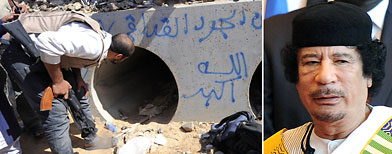
Rebels claim the ousted dictator was found hiding like a "rat" in a drainage pipe
SIRTE, Libya (Reuters) - Muammar Gaddafi called the rebels who rose up against his 42-years of one-man rule "rats," but in the end it was he who was captured cowering in a drainage pipe full of rubbish and filth.
"He called us rats, but look where we found him," said Ahmed Al Sahati, a 27-year-old government fighter, standing next to two stinking drainage pipes under a six-lane highway.
Government fighters, video evidence and the scenes of sheer carnage nearby told the story of the dictator's final hours.
Shortly before dawn prayers on Thursday, Gaddafi surrounded by a few dozen loyal bodyguards and accompanied by the head of his now non-existent army Abu Bakr Younis Jabr broke out of the two-month siege of Sirte and made a break for the west.
But they did not get far.
NATO said its aircraft struck military vehicles belonging to pro-Gaddafi forces near Sirte at about 8:30 a.m. (0630 GMT) on Thursday, but the alliance said it was unsure whether the strikes had killed Gaddafi.
Fifteen pick-up trucks mounted with heavy machine guns lay burned out, smashed and smoldering next to an electricity sub station some 20 meters from the main road, about two miles west of Sirte.
They had clearly been hit by a force far beyond anything the motley army the former rebels have assembled during eight months of revolt to overthrow the once feared leader.
But there was no bomb crater, indicating the strike may have been carried out by a helicopter gunship, or had been strafed by a fighter jet.
Inside the trucks still in their seats sat the charred skeletal remains of drivers and passengers killed instantly by the strike. Other bodies lay mutilated and contorted strewn in the grass. Some 50 bodies in all.
Gaddafi himself and a handful of his men escaped death and appeared to have ran through a stand of trees toward the main road and hid in the two drainage pipes.
But a group of government fighters were on their tail.
"At first we fired at them with anti-aircraft guns, but it was no use," said Salem Bakeer, while being feted by his comrades near the road. "Then we went in on foot.
"One of Gaddafi's men came out waving his rifle in the air and shouting surrender, but as soon as he saw my face he started shooting at me," he told Reuters.
"Then I think Gaddafi must have told them to stop. 'My master is here, my master is here', he said, 'Muammar Gaddafi is here and he is wounded'," said Bakeer.
"We went in and brought Gaddafi out. He was saying 'what's wrong? What's wrong? What's going on?'. Then we took him and put him in the car," Bakeer said.
At the time of capture, Gaddafi was already wounded with gunshots to his leg and to his back, Bakeer said.
Other government fighters who said they took part in Gaddafi's capture, separately confirmed Bakeer's version of events, though one said the man who ruled Libya for 42 years was shot and wounded at the last minute by one of his own men.
"One of Muammar Gaddafi's guards shot him in the chest," said Omran Jouma Shawan.
Army chief Jabr was also captured alive, Bakeer said. NTC officials later announced he was dead.
Fallen electricity cables partially covered the entrance to the pipes and the bodies of three men, apparently Gaddafi bodyguards lay at the entrance to one end, one in shorts probably due to a bandaged wound on his leg.
Four more bodies lay at the other end of the pipes. All black men, one had his brains blown out, another man had been decapitated, his dreadlocked head lying beside his torso.
Joyous government fighters fired their weapons in the air, shouted "Allahu Akbar" and posed for pictures. Others wrote graffiti on the concrete parapets of the highway.
"Gaddafi was captured here," said one simply.
From there Gaddafi was taken to the nearby city of Sirte where he and his dwindling band of die-hard supporters had made a last stand under a rain of missile and artillery fire in a desperate two-month siege.
Video footage showed Gaddafi, dazed and wounded, but still clearly alive and gesturing with his hands as he was dragged from a pick-up truck by a crowd of angry jostling group of government soldiers who hit him and pulled his hair.
He then appeared to fall to the ground and was enveloped by the crowd. NTC officials later announced Gaddafi had died of his wounds after capture.
Muammar Gaddafi is Dead - Libyan Prime Minister Mahmoud Jibril

showing Muammar Gaddafi's body. Gaddafi is dead after being wounded during his capture in Sirte, Libya, on October 20, 2011, according to unconfirmed reports.
Libyan dictator Moammar Gadhafi, the most wanted man in the world, has been killed, Libyan Prime Minister Mahmoud Jibril said today.
The flamboyant tyrant who terrorized his country and much of the world during his 42 years of despotic rule was reportedly cornered by insurgents in the town of Sirte, where Gadhafi had been born and was a stronghold of his supporters.
National Transition Council leaders said Gadhafi's son, Motassim, was also killed though another son, Saif Al-Islam, fled Sirte in a convoy. Three of Gadhafi's children are in Algeria, and NTC leaders say they will ask the neighboring country to send them back.
"We have been waiting for this moment for a long time. Moammar Gadhafi has been killed," Jibril said at a news conference in Tripoli.
He added that the rebel government will wait until later today or Friday to officially declare what it calls a state of liberation.
The National Transition Council earlier today said that its fighters found and shot Gadhafi in Sirte, which finally fell to the rebels today after weeks of tough fighting. Rebels now control the entire country.
An NTC fighter who says he shot Gadhafi told reporters the eccentric leader was carrying a golden pistol and pleaded to him not to shoot.
Word of Gadhafi's death triggered celebrations in the streets of Tripoli with insurgent fighters waving their weapons and dancing jubilantly.
Al Jazeera aired video of what appeared to be the dead leader, which showed Gadhafi lying in a pool of blood in the street, shirtless, and surrounded by people.
Libya's Information Minister Mahmoud Shammam told the Associated Press that Gadhafi was in a convoy when he was attacked by rebels.
A NATO official said that its jet fighters struck two military vehicles "which were part of a larger group that was maneuvering in the vicinity of Sirte conducting military operations that presented a clear threat to civilians." But NATO would not confirm whether Gadhafi was part of that convoy.
Gadhafi had been on the run for weeks after being chased out of the capital Tripoli by NATO bombers and rebel troops.
He had been believed to be hiding in the vast Libyan desert while calling on his supporters to rise up and sweep the rebel "dogs" away, but his once fearsome power was scoffed at by Libyans who had ransacked his palace compound and hounded him into hiding.
While reports of Gadhafi's death have been met with jubilation, Libya now faces a new challenge of establishing a government.
"Let us recognize immediately that this is only the end of the beginning," UN Secretary-General Ban Ki-moon said today.
Gadhafi, 69, ruled Libya with an iron fist for almost 42 years. He seized control of Libya in Sept., 1969 in a bloodless coup when he was just 27 years old. The then young and dashing army captain and his small band of military officers overthrew the monarch King Idris, setting up a new Libyan Arab Republic that over the years became increasingly isolated from the rest of the world.
Gadhafi took over the top spot as the world's most wanted man after Osama bin Laden was killed by U.S. troops in Pakistan.
At the height of his ability to threaten terrorism, President Ronald Reagan dubbed Gadhafi the "mad dog of the Middle East."
He was accused of backing the 1986 bombing of a Berlin disco popular with American soldiers, reportedly funding the hijacking of the cruise ship Achille Lauro in 1985, and the 1988 bombing of Pan Am Flight 103, which resulted in the U.N. and United States imposing sanctions on Libya.
Airtel subscribers can pay "trotro" fares with phones
GNA
Airtel Ghana subscribers can now use their mobile phone devices to transact all forms of businesses from paying utility bills to boarding Trotros (commercial vehicles) in the country.
This followed Airtel Ghana’s new innovation in its award winning mobile commerce service formerly called Zap, which has now become Airtel Mobile to allow subscribers’ mobile phone to function as a mobile wallet.
In short, the Airtel Money has the most comprehensive package of e-commerce and payment features currently in the Ghanaian market that has brought on board financial institutions, super markets/shops, utility companies among many others to help facilitate Ghana's cashless system.
“Airtel Money is the first to launch in West Africa the mobile money banking part of the service,” Mr Emmanuel Kola, Head of Airtel Money told journalists in Accra on Wednesday at an experiential seminar on the offer.
Kenya, he said, introduced the system six years ago and today the country is largely a cashless society as commuters pay their lorry fares via their mobile phones and virtually buy everything with them.
Airtel Sales Director, Luck Ochieng said, “Airtel as a company has a track record that is unrivalled in mobile telecommunications for delivering relevant and innovative mobile solutions to help customers to overcome their daily challenges.”
“Our goal...is to make communications, banking, payments and infotainment affordable and accessible to all in Africa and especially in Ghana and through Airtel Money. We have created safety by initiating a cashless society....” he added.
The enhanced Airtel Money will provide millions of people with access to banking services for the first time and has the potential to transform banking in Africa and increase access to financial services.
Airtel customers can transfer funds from person to person, can access banking services, pay their bills and transfer airtime on and across networks.
Close to two million Airtel subscribers are currently registered with the service and more than 21,000 are using it for their day to day transactions.
Airtel Ghana subscribers can now use their mobile phone devices to transact all forms of businesses from paying utility bills to boarding Trotros (commercial vehicles) in the country.
This followed Airtel Ghana’s new innovation in its award winning mobile commerce service formerly called Zap, which has now become Airtel Mobile to allow subscribers’ mobile phone to function as a mobile wallet.
In short, the Airtel Money has the most comprehensive package of e-commerce and payment features currently in the Ghanaian market that has brought on board financial institutions, super markets/shops, utility companies among many others to help facilitate Ghana's cashless system.
“Airtel Money is the first to launch in West Africa the mobile money banking part of the service,” Mr Emmanuel Kola, Head of Airtel Money told journalists in Accra on Wednesday at an experiential seminar on the offer.
Kenya, he said, introduced the system six years ago and today the country is largely a cashless society as commuters pay their lorry fares via their mobile phones and virtually buy everything with them.
Airtel Sales Director, Luck Ochieng said, “Airtel as a company has a track record that is unrivalled in mobile telecommunications for delivering relevant and innovative mobile solutions to help customers to overcome their daily challenges.”
“Our goal...is to make communications, banking, payments and infotainment affordable and accessible to all in Africa and especially in Ghana and through Airtel Money. We have created safety by initiating a cashless society....” he added.
The enhanced Airtel Money will provide millions of people with access to banking services for the first time and has the potential to transform banking in Africa and increase access to financial services.
Airtel customers can transfer funds from person to person, can access banking services, pay their bills and transfer airtime on and across networks.
Close to two million Airtel subscribers are currently registered with the service and more than 21,000 are using it for their day to day transactions.
Ghana sourcing for $300m U.S. funding to fix irregular, insufficient power supply
The Ghana government is sourcing $300 million from the Millennium Development Account (MDA) to fix the irregular and insufficient power supply challenges facing the country.
The funds are expected from the country’s share of the second compact of the MDA, meant to support some selected developing countries including Ghana.
When successful, the Ghana government would construct a 400 megawatt thermal plant in the next three years to reduce the over-reliance on hydropower generation, which energy experts had described as unreliable in recent times becauseof climate change.
The Country Director, Department of Compact Operations of the Millennium Challenge Corporation (MCC) of the United States of America (USA) , Mrs Deirdra Fair, announced this at one of the workshops dubbed “Ghana and Mozambique; A Closer Look at Power Sector Development” during the US-Africa Business Summit 2011.
The biennial summit, which was under the auspices of the Corporate Council of Africa, was meant to strengthen commercial relationships between the nations of Africa and the United States of America (USA). The summit attracted scores of businesses leaders across the world who focused on activities concerning Ghana because of its rich oil and gas find and also because of the country’s potential to become the fastest growing economy in the world from next year.
Ghana’s energy demands are said to increase at about 10 per cent per annum while generation is far below, hence the frequent shortages which demand immediate solution.
“The government of Ghana made the request for the funds to be channelled to support the energy sector and the MCC has agreed to do just that to help the country solve its energy problems”, Mrs Fair said.
From the first compact, Ghana received more than $500 million which was used to support the agricultural sector, particularly, farmers in the non-traditional export sector, infrastructure development among others.
To qualify for the compact, a country must be one that adheres to strict democratic principles, good governance, rule of law among others things.
Mrs Fair said the decision to support the energy sector of Ghana was as a result of the request made by the government and indicated that the MCC had accepted the government’s proposal and had also noticed that the MCC would release the funds when it was ready.
She said the compact, after a review of the first one, had made some changes which would go a long way to benefit beneficiary countries.
“We will also work with private partners and donors to increase the funds available to the MCC to make more funds available to support the projects proposed by the beneficiary countries including Ghana which has qualified to benefit”, she added.
A Deputy Minister of Energy, Mr Kofi Boah, later explained to the Daily Graphic that most of the transmission lines in the country were obsolete and needed to be changed to enable them to carry the load from the increasing power generated for supplies.
“This is one of the reasons the President, on the advice of strong team put together to draw Ghana’s proposal for the compact directed that we should source the funds to solve the challenges in the energy sector”, he said.
Mr Boah was not sure of how the MCC would release to the government but said “we have requested something above $300 million of which we are confident would be approved”.
He noted, however, that the total sum required to address all the challenges in the energy was in the region of about $1 billion in the next five years.
Mr Boah was, however, confident that the government would be able to provide additional resources for energy project to ensure sustained power supply to the various business ventures in the country
Source: Daily Graphic
The funds are expected from the country’s share of the second compact of the MDA, meant to support some selected developing countries including Ghana.
When successful, the Ghana government would construct a 400 megawatt thermal plant in the next three years to reduce the over-reliance on hydropower generation, which energy experts had described as unreliable in recent times becauseof climate change.
The Country Director, Department of Compact Operations of the Millennium Challenge Corporation (MCC) of the United States of America (USA) , Mrs Deirdra Fair, announced this at one of the workshops dubbed “Ghana and Mozambique; A Closer Look at Power Sector Development” during the US-Africa Business Summit 2011.
The biennial summit, which was under the auspices of the Corporate Council of Africa, was meant to strengthen commercial relationships between the nations of Africa and the United States of America (USA). The summit attracted scores of businesses leaders across the world who focused on activities concerning Ghana because of its rich oil and gas find and also because of the country’s potential to become the fastest growing economy in the world from next year.
Ghana’s energy demands are said to increase at about 10 per cent per annum while generation is far below, hence the frequent shortages which demand immediate solution.
“The government of Ghana made the request for the funds to be channelled to support the energy sector and the MCC has agreed to do just that to help the country solve its energy problems”, Mrs Fair said.
From the first compact, Ghana received more than $500 million which was used to support the agricultural sector, particularly, farmers in the non-traditional export sector, infrastructure development among others.
To qualify for the compact, a country must be one that adheres to strict democratic principles, good governance, rule of law among others things.
Mrs Fair said the decision to support the energy sector of Ghana was as a result of the request made by the government and indicated that the MCC had accepted the government’s proposal and had also noticed that the MCC would release the funds when it was ready.
She said the compact, after a review of the first one, had made some changes which would go a long way to benefit beneficiary countries.
“We will also work with private partners and donors to increase the funds available to the MCC to make more funds available to support the projects proposed by the beneficiary countries including Ghana which has qualified to benefit”, she added.
A Deputy Minister of Energy, Mr Kofi Boah, later explained to the Daily Graphic that most of the transmission lines in the country were obsolete and needed to be changed to enable them to carry the load from the increasing power generated for supplies.
“This is one of the reasons the President, on the advice of strong team put together to draw Ghana’s proposal for the compact directed that we should source the funds to solve the challenges in the energy sector”, he said.
Mr Boah was not sure of how the MCC would release to the government but said “we have requested something above $300 million of which we are confident would be approved”.
He noted, however, that the total sum required to address all the challenges in the energy was in the region of about $1 billion in the next five years.
Mr Boah was, however, confident that the government would be able to provide additional resources for energy project to ensure sustained power supply to the various business ventures in the country
Source: Daily Graphic
Health Minister campaigning as doctors strike?

The on-leave Health Minister, who has come under severe criticism for taking his leave at a time his ministry is on fire, says reports that he is campaigning in his constituency are inaccurate.
He told Joy FM’s Super Morning Show his medical leave does not require him to bed-rest. If it did, his doctors would have advised him to do so.
According to him, the advice of his doctors is that he should do some exercises, emphasizing it is the reason he is in his constituency meeting with his people, especially when it has been long since he visited the constituency.
The government, in an attempt to douse the flames ignited by the announcement of the minister's leave, issued a statement saying that “the President granted the Health Minister his request for leave on the 11th of October, 2011 purely on medical grounds.”
The Chronicle newspaper however reported that Mr Joseph Yieleh Chireh is busily campaigning in his Wa West Constituency of the Upper West Region.
According to the paper, “Mr Yieleh Chireh was at the Dabu Electoral Area in the Upper West Region on Tuesday, holding meetings with NDC executives in the constituency, in a bid to retain him to contest the [parliamentary] elections" next year.
The Health Minister is expected to visit the Boro electoral area at 10:00 a.m. Wednesday, before dashing to the Boriman Electoral Area at mid-day.
Mr Yieleh Chireh however insists he is on medical leave but admits he has been interacting with his constituents.
Mr Yieleh Chireh said his personal involvement is not necessarily required to resolve the doctors’ strike, stressing the need for emphasis to be placed on institutional mechanisms to address the grievances of the striking doctors
Subscribe to:
Posts (Atom)