
Ghana Telescope
New York - Accra - London
LONGVIEW, Wash. (AP) — Police in Washington state say a shoplifter with a hatchet sliced off most of a store security guard's ear.
Longview police Sgt. Doug Kazensky tells The Daily News that the shoplifter pulled a small hatchet out of his waistband Monday afternoon and swung, chopping off nearly the entire ear.
The guard was taken to a Portland hospital for emergency plastic surgery in an attempt to reattach the ear.
The attacker remained at large.
The assault took place just outside the garden center entrance of a Fred Meyer supermarket. Kazensky says two security officers were trying to apprehend the man, who was suspected of taking CDs, bike chains and other small items.
The man apparently brought the hatchet to the store with him.
Tuesday, December 13, 2011


Saudi Arabia executes woman convicted of 'sorcery'
Ghana Telescope
RIYADH, Saudi Arabia (AP) — Saudi authorities have executed a woman convicted of practicing magic and sorcery.
The Saudi Interior Ministry says in a statement the execution took place Monday, but gave no details on the woman's crime.
The London-based al-Hayat daily, however, quoted Abdullah al-Mohsen, chief of the religious police who arrested the woman, as saying she had tricked people into thinking she could treat illnesses, charging them $800 per session.
The paper said a female investigator followed up, and the woman was arrested in April, 2009, and later convicted in a Saudi court.
It did not give the woman's name, but said she was in her 60s.
The execution brings the total to 76 this year in Saudi Arabia, according to an Associated Press count. At least three have been women.
RIYADH, Saudi Arabia (AP) — Saudi authorities have executed a woman convicted of practicing magic and sorcery.
The Saudi Interior Ministry says in a statement the execution took place Monday, but gave no details on the woman's crime.
The London-based al-Hayat daily, however, quoted Abdullah al-Mohsen, chief of the religious police who arrested the woman, as saying she had tricked people into thinking she could treat illnesses, charging them $800 per session.
The paper said a female investigator followed up, and the woman was arrested in April, 2009, and later convicted in a Saudi court.
It did not give the woman's name, but said she was in her 60s.
The execution brings the total to 76 this year in Saudi Arabia, according to an Associated Press count. At least three have been women.
Sunday, December 11, 2011
South Korean coastguard "killed by Chinese fisherman"
SEOUL (Reuters) - A South Korean coastguard was stabbed to death by a Chinese fisherman Monday in an operation to apprehend a Chinese vessel operating illegally near South Korean waters, a South Korean official said.
Two South Koreans were stabbed in the operation in the Yellow Sea off the west coast near the border with North Korea, the coastguard said.
Chinese fishing boats are frequently caught fishing in South Korean waters, sometimes leading to violent clashes with South Korean maritime police.
"One officer is dead. There is another one injured. There are no other injuries," a coastguard officer said. "It happened in the EEZ (exclusive economic zone), outside the territorial waters, but it's still illegal fishing."
South Korea's Yonhap news agency said the coastguard had seized the vessel and nine sailors on board.
There was no immediate comment from Beijing.
South Korea last month vowed a crackdown on illegal fishing by Chinese fishing boats in its EEZ.
Some 2,600 Chinese fishing boats have been caught illegally fishing in the South Korean EEZ since 2006 and nearly 800 Chinese fishermen have been arrested, Yonhap reported.
In the first 11 months of this year, some 440 Chinese fishing boats were caught illegally fishing in South Korean waters, up 46 percent from a year earlier, it said.
Two South Koreans were stabbed in the operation in the Yellow Sea off the west coast near the border with North Korea, the coastguard said.
Chinese fishing boats are frequently caught fishing in South Korean waters, sometimes leading to violent clashes with South Korean maritime police.
"One officer is dead. There is another one injured. There are no other injuries," a coastguard officer said. "It happened in the EEZ (exclusive economic zone), outside the territorial waters, but it's still illegal fishing."
South Korea's Yonhap news agency said the coastguard had seized the vessel and nine sailors on board.
There was no immediate comment from Beijing.
South Korea last month vowed a crackdown on illegal fishing by Chinese fishing boats in its EEZ.
Some 2,600 Chinese fishing boats have been caught illegally fishing in the South Korean EEZ since 2006 and nearly 800 Chinese fishermen have been arrested, Yonhap reported.
In the first 11 months of this year, some 440 Chinese fishing boats were caught illegally fishing in South Korean waters, up 46 percent from a year earlier, it said.
Israel PM plans Africa trip over migrant issue

JERUSALEM (AFP) - Israeli Prime Minister Benjamin Netanyahu will visit Africa to discuss illegal migration from the continent to the Jewish state, he said on Sunday, as his cabinet approved new measures to combat the problem.
Speaking ahead of a cabinet meeting to approve ways to deal with an influx of illegal migrants, Netanyahu announced "I intend to travel to Africa later to discuss and advance procedures for returning them (migrants) to Africa."
The Israeli premier gave no indication of which countries he would visit or when he would travel, but he stressed that he considered the arrival of illegal migrants a serious issue.
"This is a national calamity, in every field," he said. "We have no obligation to accept illegal infiltrators, and I distinguish between them and the question of refugees, who are but a minuscule component of this human deluge."
On Sunday, the cabinet approved the allocation of 630 million shekels ($167 million, 124 million euros) for new measures to tackle the issue.
The programme approved includes stepped-up measures against Israelis employing illegal migrants and expedited construction of a security barrier along the border with Egypt.
It also provides funds for the construction of a new detention facility and extends the period that illegal migrants can be detained to three years.
According to data presented to the cabinet, there are currently 52,487 illegal economic migrants in Israel.
Netanyahu stressed his plan wasn't aimed at refugees, rather "entire populaces that are moving toward Israel, which is a very developed and humane country."
"If we don't stop this illegal flood, we'll be washed away by it," he warned.
Activists argue that the government figures misrepresent the number of migrants who are legitimate asylum seekers and accuse the authorities of turning away those in need.
But communities most affected by the influx, including the southern town of Eilat, have long lobbied the government to take stronger measures to stem the arrivals.
Iran says it will not return US drone
TEHRAN, Iran (AP) — Iran will not return a U.S. surveillance drone captured by its armed forces, a senior commander of the country's elite Revolutionary Guard said Sunday.
Gen. Hossein Salami, deputy head of the Guard, said in remarks broadcast on state television that the violation of Iran's airspace by the U.S. drone was a "hostile act" and warned of a "bigger" response. He did not elaborate on what Tehran might do.
"No one returns the symbol of aggression to the party that sought secret and vital intelligence related to the national security of a country," Salami said.
Iranian television broadcast video Thursday of Iranian military officials inspecting what it identified as the RQ-170 Sentinel drone.
Iranian state media have said the unmanned spy aircraft was detected over the eastern town of Kashmar, some 140 miles (225 kilometers) from the border with Afghanistan. U.S. officials have acknowledged losing the drone.
Salami called its capture a victory for Iran and a defeat for the U.S. in a complicated intelligence and technological battle.
"Iran is among the few countries that possesses the most modern technology in the field of pilotless drones. The technology gap between Iran and the U.S. is not much," he said.
Officers in the Guard, Iran's most powerful military force, had previously claimed that the country's armed forces brought down the surveillance aircraft with an electronic ambush, causing minimum damage to the drone.
American officials have said that U.S. intelligence assessments indicate that Iran neither shot the drone down, nor used electronic or cybertechnology to force it from the sky. They contend the drone malfunctioned. The officials had spoken anonymously in order to discuss the classified program.
But Salami refused to provide more details of Iran's claim to have captured the CIA-operated aircraft.
"A party that wins in an intelligence battle doesn't reveal its methods. We can't elaborate on the methods we employed to intercept, control, discover and bring down the pilotless plane," he said.
Gen. Hossein Salami, deputy head of the Guard, said in remarks broadcast on state television that the violation of Iran's airspace by the U.S. drone was a "hostile act" and warned of a "bigger" response. He did not elaborate on what Tehran might do.
"No one returns the symbol of aggression to the party that sought secret and vital intelligence related to the national security of a country," Salami said.
Iranian television broadcast video Thursday of Iranian military officials inspecting what it identified as the RQ-170 Sentinel drone.
Iranian state media have said the unmanned spy aircraft was detected over the eastern town of Kashmar, some 140 miles (225 kilometers) from the border with Afghanistan. U.S. officials have acknowledged losing the drone.
Salami called its capture a victory for Iran and a defeat for the U.S. in a complicated intelligence and technological battle.
"Iran is among the few countries that possesses the most modern technology in the field of pilotless drones. The technology gap between Iran and the U.S. is not much," he said.
Officers in the Guard, Iran's most powerful military force, had previously claimed that the country's armed forces brought down the surveillance aircraft with an electronic ambush, causing minimum damage to the drone.
American officials have said that U.S. intelligence assessments indicate that Iran neither shot the drone down, nor used electronic or cybertechnology to force it from the sky. They contend the drone malfunctioned. The officials had spoken anonymously in order to discuss the classified program.
But Salami refused to provide more details of Iran's claim to have captured the CIA-operated aircraft.
"A party that wins in an intelligence battle doesn't reveal its methods. We can't elaborate on the methods we employed to intercept, control, discover and bring down the pilotless plane," he said.
Medvedev orders Russia poll inquiry after protests
MOSCOW (Reuters) - President Dmitry Medvedev ordered an investigation Sunday into allegations of fraud in Russia's parliamentary election, one day after tens of thousands of protesters demanded it be annulled and rerun.
Medvedev responded on his Facebook site to the protesters' complaints that the December 4 election was slanted to favor of his and Prime Minister Vladimir Putin's United Russia party, but did not mention their calls for an end to Putin's rule.
"I do not agree with any slogans or statements made at the rallies. Nevertheless, instructions have been given by me to check all information from polling stations regarding compliance with the legislation on elections," Medvedev said in a post on the social media site.
"Citizens of Russia have freedom of speech and freedom of assembly. People have a right to express the position that they did yesterday. It all took place within the framework of the law," he added.
His statement was a sign that the Russian leadership feels under pressure after the biggest opposition protests since Putin rose to power in 1999. The protesters themselves used social media to organize their rallies.
In a further sign of recognition that the people's mood has changed after years of tight political control by Putin, city authorities across Russia allowed Saturday's protests to go ahead and riot police hardly intervened.
State television and other Russian channels also broadcast footage of a huge protest in Moscow, breaking a policy of showing almost no negative coverage of the authorities.
But Medvedev had already indicated before the protests that he would call an inquiry, and a statement from Putin's spokesman, Dmitry Peskov, gave no indication that the prime minister was about to make big concessions to the protesters.
"We respect the point of view of the protesters, we are hearing what is being said, and we will continue to listen to them," Peskov said in a statement released late Saturday.
That is unlikely to appease protesters who issued a list of demands at the Moscow rally, which police said was attended by 25,000 people and the organizers said attracted up to 150,000.
PROTESTERS LIST THEIR DEMANDS
The demands included much more than just an investigation in the conduct of the election, which international monitors and the United States said was slanted to help United Russia secure a majority in the State Duma lower house.
The protesters demanded a rerun of the election, the sacking of Central Election Commission chief Vladimir Churov and the release of people they define as political prisoners. The organizers also called for a new day of protests on December 24.
"I am happy. December 10, 2011 will go down in history as the day the country's civic virtue and civil society was revived. After 10 years of hibernation, Moscow and all Russia woke up," Boris Nemtsov, an opposition leader, wrote in his blog.
"The main reason why it was such a big success is that a feeling of self-esteem has awakened in us and we have all got so fed up with Putin's and Medvedev's lies, theft and cynicism that we cannot tolerate it any longer ... Together we will win!"
It may not be that simple. The opposition has long been divided, most mainstream parties have little or no role in the rallies and keeping them up across the world's largest country is hard at the best of times but especially in winter.
Most Russian political experts say Putin, the former KGB spy who has dominated the world's largest energy producer for 12 years, is in little immediate danger of being toppled, despite anger over widespread corruption and the gap between rich and poor.
But they say the 59-year-old leader's authority has been damaged and may gradually wane after he returns as president in an election next March that he is still expected to win.
Although opinion polls show he is Russia's most popular politician, the protests indicate how deep feelings are over the December 4 election. The biggest were in Moscow and St Petersburg, the two biggest cities and the main centers of Russia's middle class, but smaller rallies took place across the country.
TOUGH TASK AHEAD
"Putin has a formidable task. He has lost Moscow and St Petersburg, crucial cities where everything usually starts," said political analyst and author Liliya Shevtsova. "He looks out of touch."
Putin, as president for eight years until 2008 and as prime minister since then, built up a strongman image by restoring order after the chaos in the decade after the Soviet Union's collapse in 1991. But he no longer seems invincible.
He could release the state's purse strings to satisfy the financial demands of some critics but many of the protesters in Moscow are middle-class people demanding more fundamental changes, including relaxing the political system he controls.
His charges last week that the United States encouraged the protesters and financed them provoked scorn on the Internet.
Answering calls to protests on social media sites, a huge crowd gathered in Moscow's Bolotnaya Square Saturday, many carrying white carnations as a symbol of protest. Some waved pictures of Putin and Medvedev saying: "Guys, it's time to go."
Felix, 68, a retired military officer who declined to give his surname, said in Moscow he wanted Putin out, but had no hope this could be accomplished through elections. "There is no way to change those in power within the electoral system they have set up, so we need to use other methods," he said.
Medvedev responded on his Facebook site to the protesters' complaints that the December 4 election was slanted to favor of his and Prime Minister Vladimir Putin's United Russia party, but did not mention their calls for an end to Putin's rule.
"I do not agree with any slogans or statements made at the rallies. Nevertheless, instructions have been given by me to check all information from polling stations regarding compliance with the legislation on elections," Medvedev said in a post on the social media site.
"Citizens of Russia have freedom of speech and freedom of assembly. People have a right to express the position that they did yesterday. It all took place within the framework of the law," he added.
His statement was a sign that the Russian leadership feels under pressure after the biggest opposition protests since Putin rose to power in 1999. The protesters themselves used social media to organize their rallies.
In a further sign of recognition that the people's mood has changed after years of tight political control by Putin, city authorities across Russia allowed Saturday's protests to go ahead and riot police hardly intervened.
State television and other Russian channels also broadcast footage of a huge protest in Moscow, breaking a policy of showing almost no negative coverage of the authorities.
But Medvedev had already indicated before the protests that he would call an inquiry, and a statement from Putin's spokesman, Dmitry Peskov, gave no indication that the prime minister was about to make big concessions to the protesters.
"We respect the point of view of the protesters, we are hearing what is being said, and we will continue to listen to them," Peskov said in a statement released late Saturday.
That is unlikely to appease protesters who issued a list of demands at the Moscow rally, which police said was attended by 25,000 people and the organizers said attracted up to 150,000.
PROTESTERS LIST THEIR DEMANDS
The demands included much more than just an investigation in the conduct of the election, which international monitors and the United States said was slanted to help United Russia secure a majority in the State Duma lower house.
The protesters demanded a rerun of the election, the sacking of Central Election Commission chief Vladimir Churov and the release of people they define as political prisoners. The organizers also called for a new day of protests on December 24.
"I am happy. December 10, 2011 will go down in history as the day the country's civic virtue and civil society was revived. After 10 years of hibernation, Moscow and all Russia woke up," Boris Nemtsov, an opposition leader, wrote in his blog.
"The main reason why it was such a big success is that a feeling of self-esteem has awakened in us and we have all got so fed up with Putin's and Medvedev's lies, theft and cynicism that we cannot tolerate it any longer ... Together we will win!"
It may not be that simple. The opposition has long been divided, most mainstream parties have little or no role in the rallies and keeping them up across the world's largest country is hard at the best of times but especially in winter.
Most Russian political experts say Putin, the former KGB spy who has dominated the world's largest energy producer for 12 years, is in little immediate danger of being toppled, despite anger over widespread corruption and the gap between rich and poor.
But they say the 59-year-old leader's authority has been damaged and may gradually wane after he returns as president in an election next March that he is still expected to win.
Although opinion polls show he is Russia's most popular politician, the protests indicate how deep feelings are over the December 4 election. The biggest were in Moscow and St Petersburg, the two biggest cities and the main centers of Russia's middle class, but smaller rallies took place across the country.
TOUGH TASK AHEAD
"Putin has a formidable task. He has lost Moscow and St Petersburg, crucial cities where everything usually starts," said political analyst and author Liliya Shevtsova. "He looks out of touch."
Putin, as president for eight years until 2008 and as prime minister since then, built up a strongman image by restoring order after the chaos in the decade after the Soviet Union's collapse in 1991. But he no longer seems invincible.
He could release the state's purse strings to satisfy the financial demands of some critics but many of the protesters in Moscow are middle-class people demanding more fundamental changes, including relaxing the political system he controls.
His charges last week that the United States encouraged the protesters and financed them provoked scorn on the Internet.
Answering calls to protests on social media sites, a huge crowd gathered in Moscow's Bolotnaya Square Saturday, many carrying white carnations as a symbol of protest. Some waved pictures of Putin and Medvedev saying: "Guys, it's time to go."
Felix, 68, a retired military officer who declined to give his surname, said in Moscow he wanted Putin out, but had no hope this could be accomplished through elections. "There is no way to change those in power within the electoral system they have set up, so we need to use other methods," he said.
Friday, December 9, 2011
DR Congo election: Joseph Kabila 're-elected'
President Joseph Kabila has won the Democratic Republic of Congo's election, provisional results show.
He obtained 49% of the vote against 32% for veteran opposition leader Etienne Tshisekedi, the election commission chief said.
The announcement has been delayed since Tuesday, with election officials blaming logistical problems.
The opposition has complained of fraud and security is tight in the capital, Kinshasa, amid fears of violence.
Riot police are patrolling the streets of the capital, which is seen as an opposition stronghold.
In the eastern city of Goma, people started to celebrate as soon as the results were announced on national TV and radio, reports the BBC's Joshua Mmali in the city.
The results still have to be ratified by the Supreme Court.
He obtained 49% of the vote against 32% for veteran opposition leader Etienne Tshisekedi, the election commission chief said.
The announcement has been delayed since Tuesday, with election officials blaming logistical problems.
The opposition has complained of fraud and security is tight in the capital, Kinshasa, amid fears of violence.
Riot police are patrolling the streets of the capital, which is seen as an opposition stronghold.
In the eastern city of Goma, people started to celebrate as soon as the results were announced on national TV and radio, reports the BBC's Joshua Mmali in the city.
The results still have to be ratified by the Supreme Court.
India hospital fire in Calcutta kills dozens

At least 73 people have been killed in a fire that broke out in a hospital in the eastern Indian city of Calcutta (Kolkata), officials say.
Most of the victims were patients who were trapped after the flames spread through the AMRI hospital.
The fire started in the multi-storey hospital's basement, where flammable materials were stored. Firefighters took five hours to control the blaze.
Six board members of the hospital have been arrested.
West Bengal Chief Minister Mamata Banerjee said the licence of the six-storey hospital in Dhakuria in the southern part of the city had been cancelled.
She said the fire was an "unforgivable crime" and that those responsible would be given the harshest punishment.
A Upadhay, a senior vice-president of the AMRI hospital company, told Associated Press there were 160 patients in the 190-bed hospital.
A spokesman for Manmohan Singh said the prime minister had "expressed shock and anguish over the loss of lives".
Chaotic scenes
West Bengal Urban Development Minister Firhad Hakim said many of the patients who died had suffocated on fumes.
A number were rescued. "We have taken 50 patients to an adjacent hospital. The situation is grim at the moment," fire brigade chief Gopal Bhattacharya told Agence France-Presse news agency.
The BBC's Amitabha Bhattasali in Calcutta says bodies of patients wrapped in white sheets have been brought out by rescue workers.
Local people climbed into the hospital compound to rescue patients before fire engines arrived, our correspondent says.
The narrow surrounding streets made it difficult for the rescue services to arrive quickly.
There were chaotic scenes when Ms Banerjee arrived.
Relatives of patients complained that her convoy had blocked the passage of ambulances in the hospital complex.
Police resorted to a baton charge as the crowds moved forward to Ms Banerjee's car.
"Stop it. What is this? No baton charge! Have you come here to beat up people?" the Times of India newspaper quoted Ms Banerjee as telling the officers.
Police told AP the six hospital officials arrested were being questioned on charges of culpable homicide and that they had surrendered voluntarily.
'A lot of bodies'
The fire had spread swiftly from the basement to the upper floors of the private hospital.
Television pictures showed patients being carried out on stretchers.
One rescued patient said: "The attendants woke me up and dragged me down the stairs. I saw 10-15 patients at the top of the stairs trying to get down."
Ananya Das, 35, who underwent surgery at the hospital on Thursday, said she was recovering when the fire broke out.
"I managed to walk towards an exit and then climb out of a window. I saw a lot of bodies," she said.
One relative, Khokon Chakravathi, told AFP: "My mother is in the intensive care unit. She's 70 years old. I don't know if she is alive or not."
Fires in high-rise buildings are fairly common in the city. There have been at least 10 major incidents since 2008.
Electrical short circuits have been responsible for most of these fires.
More than 40 people died in a huge fire in a historic building in Calcutta in March last year.
Armed Nigeria militia marches through largest city
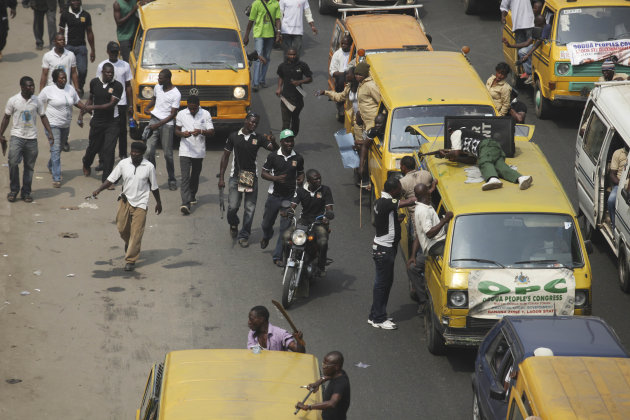
Unidentified members of Oodua People's Congress militia ride on buses carrying guns and machetes during a protest against Boko Haram in Lagos, Nigeria,Thursday, Dec. 8, 2011. The militia group from Nigeria's southwest walked through the streets of the commercial capital firing rifles as police and security forces fled. The group said they were protesting the rise of Boko Haram, a violent Muslim sect in the country's northeast which they claim are responsible for bombings and assassinations
LAGOS, Nigeria (AP) — The armed militia marched unstopped through Nigeria's largest city, firing shotguns and rifles in the air in what they called a protest against a radical Muslim sect responsible for killings across the oil-rich country.
The demonstration Thursday by members of the Oodua People's Congress highlighted the growing sense of insecurity and widening distrust among Nigeria's more than 160 million people and its major ethnic groups. Men armed with shotguns, rifles and machetes freely roamed the streets of Lagos without a sign of police, while passers-by shouted that their region of Nigeria should be protected — rather than the country as a whole.
"We don't want them to fight here in our Lagos because Lagos is for everybody, not for Yoruba alone, but for everybody," said Chief Orebiyi Ebenezer, a militia leader. "We need peace here in Lagos."
The Oodua People's Congress is a militia made up of Nigeria's Yoruba ethnic group, which dominates the country's southwest. The party takes its name from Oduduwa, the ancestor of the Yoruba race, and formed after military ruler Ibrahim Babangida annulled a presidential election in 1993 that many believe a wealthy Yoruba businessman won.
The group evolved into a quasi-political organization and likely receives the implicit support of major politicians in the region, though its members have been implicated in political violence and thuggery. Rumors abound in Nigeria's southwest that the group maintains a stockpile of firearms in a country where those weapons are strictly regulated by law, if not practice.
Those rumors appeared true as about 100 armed members riding in minibuses and marching by foot came into Lagos on Thursday, home to 15 million people. They fired long rifles and locally made shotguns into the air, unstopped by police as they ended up at Teslim Balogun Stadium, which hosted FIFA's Under-17 World Cup in 2009.
Leke Akintayo, a militia leader, said their protest was a show of force against Boko Haram, a Muslim sect in Nigeria's northeast that has killed at least 388 people this year alone, according to an Associated Press count. The group also claimed responsibility for the Aug. 26 bombing of the United Nations headquarters in Nigeria's capital Abuja as part of its campaign for the implementation of strict Shariah law across the nation.
"We OPC, we still exist," Akintayo said. "They should not fall (under) our hand. ... This is our father's land."
He added: "We are going to retaliate if there is any bomb blast hitting any place. We are ready for them. Anytime, any moment."
How the group would retaliate remains unclear, but Lagos remains a melting pot city for Nigeria's more than 250 ethnic groups. At risk would be those belonging to the Hausa Fulani ethnic group, Muslims who dominate the country's north.
Such ethnic-based violence remains all too common in Nigeria. Since the nation became a democracy in 1999, tens of thousands have died in communal violence that cuts across religious and ethnic lines, but often takes root in political or economic issues.
Different groups in Nigeria's south have claimed they would fight Boko Haram if the government fails to stop the group, including militants in the country's oil-rich and restive Niger Delta. However, Thursday's march represented the first time a militia took the street armed to display and threaten using force to end the violence.
That threat mixed with theater at one point as one man holding a pump-action shotgun walked by journalists and said in Yoruba: "Should we shoot it for you?" He racked a shell into the shotgun and fired as he walked down the busy street filled with uniformed school children trying to get home.
Iran releases video of downed U.S. spy drone–looking intact

Iran's Press TV on Thursday broadcast an extended video tour of the U.S. spy drone that went down in the country--and it indeed appeared to look mostly intact.
American officials have acknowledged that an unmanned U.S. reconnaissance plane was lost on a mission late last week, but have insisted that there is no evidence the drone was downed by hostile acts by Iran. Rather, they said, the drone likely went down because of a malfunction, and they implied the advanced stealth reconnaissance plane would likely have fallen from such a high altitude--the RQ-170 Sentinel can fly as high as 50,000 feet--that it wouldn't be in good shape.
But Iranian military officials have claimed since Sunday that they brought down an American spy drone that was little damaged. And now they have provided the first visual images of what looks to be a drone that at least outwardly appears to be in decent condition, in what is surely another humiliating poke in the eye for U.S. national security agencies.
The Pentagon declined to comment on the released images Thursday, a Defense Department spokesman told Yahoo News. But military analysts said it appeared to them to be the American drone in question.
"I have been doing this for thirty years, and it sure looks like" a stealthy U.S. drone to me," Loren Thompson, a military analyst with the Lexington Institute and consultant to the RQ-170's manufacturer, Lockheed Martin, told Yahoo News in a telephone interview Thursday. "I think we are going to face the high likelihood that Iran has an intact version of one of our most important intelligence gathering tools."
Still, Thompson went on, the intelligence "windfall" to Iran from obtaining the advanced U.S. stealthy drone may be mitigated.
"I don't think the Iranians get as much out of it as they might hope," he said. "It probably came into their hands as a result of a technical malfunction. What that means is they still don't have a real defense against the U.S. flying other vehicles that have similar capabilities, without much fear of interception."
Analysts also noted that the video of the drone released by Iran did not show the drone's underside. "Pretty intact," the Center for Strategic and International Studies' James Lewis said by email. "Interesting that they covered the underside."
The New York Times reported Thursday that--unsurprisingly--the RQ-170 was lost while making the latest foray over Iran during an extended CIA surveillance effort of Iran's nuclear and ballistic weapons program.
"The overflights by the bat-winged RQ-170 Sentinel, built by Lockheed Martin and first glimpsed on an airfield in Kandahar, Afghanistan, in 2009, are part of an increasingly aggressive intelligence collection program aimed at Iran, current and former officials say," the Times' Scott Shane and David Sanger wrote. "The urgency of the effort has been underscored by a recent public debate in Israel about whether time is running out for a military strike to slow Iran's progress toward a nuclear weapon."
Iran in turn has complained that the drone overflights represent an act of aggression and violation of its sovereignty, and summoned the Swiss envoy--who represents U.S. interests in Iran--on Thursday to lodge a protest.
However, while the images of the U.S. drone surely allowed Iran to score another public relations blow against Washington, Iran may find it tough to generate much in the way of international sympathy for being the target of U.S. surveillance.
Last week, Iranian hardliners ransacked the British embassy in Tehran, prompting the United Kingdom to recall its diplomatic staff from Tehran and order Iran's embassy in London closed. Last month, the UN atomic watchdog agency issued a report raising concerns about research Iran is suspected by some nations to have conducted before 2003 on military aspects of its nuclear program. Iran has insisted its nuclear program is for peaceful energy purposes. In October, the United States accused elements of Iran's Qods force of plotting to assassinate the Saudi envoy to the United States. The United Nations General Assembly voted last month in favor of a resolution condemning the Iranian plot.
Amid its growing international isolation, Iran, unsurprisingly, seemed intent to play up the drone incident for all it could.
"China, Russia want to inspect downed U.S. drone," proclaimed a headline from Iran's Mehr news agency Thursday.
The RQ-170 Sentinel, however, reportedly did not use the latest U.S. surveillance technology on board, in part because as a single-engine aircraft, it was thought more likely to occasionally go down.
"The basic principles of stealthy aircraft are fairly well known," Thompson said. "In terms of [the drone's] on-board electronics and information systems, it is fairly routine in combat to require authentication codes to make them hard to unlock."
Wednesday, December 7, 2011
Partial results give Congo's Kabila 14-point lead
KINSHASA, Congo (AP) — Partial results issued by Congo's electoral commission overnight make it all but certain that President Joseph Kabila will be declared the winner, setting the stage for possible clashes between his backers and those loyal to the main opposition candidate.
Supporters of longtime opposition leader Etienne Tshisekedi have vowed to take to the streets if Kabila is declared the winner.
Just before midnight Tuesday, election commission chief Daniel Ngoy Mulunda announced that the commission will require another 48 hours to issue the final provisional results. The delay, he said, is due to the fact that tally sheets from numerous provinces have still not been turned in. Helicopters have been dispatched to try to collect them in this vast largely roadless central African nation.
With 89.2 percent of precincts counted, Kabila had 8.3 million out of the 17.3 million votes, or 48 percent. Tshisekedi was trailing with 5.9 million votes, or 34 percent. The results were published Wednesday on the website of a United Nations-backed broadcaster, Radio Okapi.
Late Tuesday, members of Kabila's ruling party crowded inside Kinshasa's Grand Hotel for a festive celebration.
The threat of unrest hung over this troubled capital and international airlines canceled their flights. The U.S. Embassy ordered its staff and their families not to leave their homes until further notice. The American School of Kinshasa will be closed.
Last week's voting was marred by technical glitches, including the late delivery of ballots, some of which didn't reach polling stations until three days after the vote was supposed to take place. Even though it was clear that the election commission was not prepared for last week's ballot, the government rushed ahead with the election because the current president's five-year term expired Tuesday at midnight.
The 48-hour delay means that Kabila will be staying in office past his legal mandate. Analysts say the country could slide into a situation of unconstitutional power which could stoke tension in Congo.
"As we haven't yet been able to receive the tally sheets from all 60,000 polling stations in the country, we decided to push back the publication by 48 hours," said Matthieu Mpita, the spokesman of the National Independent Electoral Commission. "It was our objective to make the deadline," he said, "but we need all the elements."
On state television, coverage of a soccer match was interrupted so a statement from the election commission announcing the 48-hour delay could be read.
Congo is staging only its second democratic election and the process has been flawed at every step, from the late printing and delivery of ballots, to the chaotic counting centers where trucks were dumping containers filled with ballots and frequent power cuts interrupted the entry of data.
Over 3 million people registered to vote in the capital, Kinshasa, and observers say that only two of the four vote tabulation centers there had finished compiling results by Tuesday afternoon. Even at those two hubs, poll workers had misplaced results from hundreds of polling stations, said observers.
They were sorting through mountains of rice sacks containing ballots desperately trying to find them, said David Pottie of the Carter Center, the Atlanta-based observation mission established by former President Jimmy Carter.
Near the headquarters of the main opposition party, police fired tear gas and blasted water cannons to disperse supporters of 78-year-old Tshisekedi, witnesses said.
Election violence has already left at least 18 dead and more than 100 wounded, with most of the deaths caused by troops loyal to Kabila, according to Human Rights Watch.
Congo's back-to-back civil wars in the 1990s consumed the region. The country is ranked dead last on the United Nations' global survey of human development.
Although observers said they have not witnessed systematic fraud, only widespread irregularities, the impression among opposition supporters is that the vote is being manipulated in Kabila's favor.
Supporters of longtime opposition leader Etienne Tshisekedi have vowed to take to the streets if Kabila is declared the winner.
Just before midnight Tuesday, election commission chief Daniel Ngoy Mulunda announced that the commission will require another 48 hours to issue the final provisional results. The delay, he said, is due to the fact that tally sheets from numerous provinces have still not been turned in. Helicopters have been dispatched to try to collect them in this vast largely roadless central African nation.
With 89.2 percent of precincts counted, Kabila had 8.3 million out of the 17.3 million votes, or 48 percent. Tshisekedi was trailing with 5.9 million votes, or 34 percent. The results were published Wednesday on the website of a United Nations-backed broadcaster, Radio Okapi.
Late Tuesday, members of Kabila's ruling party crowded inside Kinshasa's Grand Hotel for a festive celebration.
The threat of unrest hung over this troubled capital and international airlines canceled their flights. The U.S. Embassy ordered its staff and their families not to leave their homes until further notice. The American School of Kinshasa will be closed.
Last week's voting was marred by technical glitches, including the late delivery of ballots, some of which didn't reach polling stations until three days after the vote was supposed to take place. Even though it was clear that the election commission was not prepared for last week's ballot, the government rushed ahead with the election because the current president's five-year term expired Tuesday at midnight.
The 48-hour delay means that Kabila will be staying in office past his legal mandate. Analysts say the country could slide into a situation of unconstitutional power which could stoke tension in Congo.
"As we haven't yet been able to receive the tally sheets from all 60,000 polling stations in the country, we decided to push back the publication by 48 hours," said Matthieu Mpita, the spokesman of the National Independent Electoral Commission. "It was our objective to make the deadline," he said, "but we need all the elements."
On state television, coverage of a soccer match was interrupted so a statement from the election commission announcing the 48-hour delay could be read.
Congo is staging only its second democratic election and the process has been flawed at every step, from the late printing and delivery of ballots, to the chaotic counting centers where trucks were dumping containers filled with ballots and frequent power cuts interrupted the entry of data.
Over 3 million people registered to vote in the capital, Kinshasa, and observers say that only two of the four vote tabulation centers there had finished compiling results by Tuesday afternoon. Even at those two hubs, poll workers had misplaced results from hundreds of polling stations, said observers.
They were sorting through mountains of rice sacks containing ballots desperately trying to find them, said David Pottie of the Carter Center, the Atlanta-based observation mission established by former President Jimmy Carter.
Near the headquarters of the main opposition party, police fired tear gas and blasted water cannons to disperse supporters of 78-year-old Tshisekedi, witnesses said.
Election violence has already left at least 18 dead and more than 100 wounded, with most of the deaths caused by troops loyal to Kabila, according to Human Rights Watch.
Congo's back-to-back civil wars in the 1990s consumed the region. The country is ranked dead last on the United Nations' global survey of human development.
Although observers said they have not witnessed systematic fraud, only widespread irregularities, the impression among opposition supporters is that the vote is being manipulated in Kabila's favor.
Protest in Libya capital against former rebels
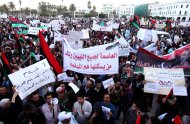
Square in a rally organised by the city council and backed by the interim government.
"Safety comes when there are no weapons," teacher Salwa Lamir, dressed in a black hijab, told AFP as she held a banner reading: "No weapons in Tripoli."
"We're protesting against weapons and people using weapons. I want the militias who came from outside Tripoli to leave. They have to go back to their homes and continue with their studies," she said.
Around her the crowd chanted "The people want safety!"
On Tuesday, the interim government gave its firm support to a two-week deadline for militias to quit Tripoli, backing up a threat from the capital's council to lock down the city if they fail to do so by December 20.
The militias, mostly from the cities of Misrata and Zintan, took part in the liberation of Tripoli in August and have been in the city ever since, often occupying buildings to use as their headquarters.
They have manned checkpoints on key roads and also at installations such as the capital's international airport.
Pressure to disarm the former rebels in Tripoli has mounted after local media reported several skirmishes between various factions in recent weeks.
On October 5, the country's new leaders ordered all heavy weapons removed from Tripoli, warning that their prolonged presence risked giving a bad image to the revolution which ousted Kadhafi who was later killed on October 20.
"These militias even intervene in police work, often asking us to free comrades of theirs held by us. This obstructs the application of the law," said one agitated policeman, Mustafa Salem, on Wednesday.
Behind him dozens of officers walked in the square shouting "Libya is free now, the militias must leave!" as others sounded the horns of police vehicles.
Another resident, Mohammed Seghaier, said the capital was becoming dangerous.
"They are causing problems. We want the rebels from outside Tripoli to go as the city is becoming dangerous," he said, adding that security must now be in hands of the national army and police.
When asked if the police and army can guarantee security, he said: "Yes. With the help of Tripoli rebels, the police can offer security."
But a rebel from Misrata, the third largest city in Libya, blamed the recent incidents on members of "Kadhafi's fifth column" who he said had infiltrated some militias.
"It is the fifth column which is creating these problems, not us," said Hamza Ghanem, whose comrades from Misrata captured and killed Kadhafi in the dictator's hometown Sirte on October 20.
Ghanem, himself a veteran of the Sirte battle, said he and other Misrata fighters in Tripoli were helping protect the city.
"Our group is protecting the National Oil Company building and offering security to employees there. We are ready to leave Tripoli the moment our commanders tell us," he said, denying he had weapons as he roamed the streets in a four-wheel drive vehicle.
Dozens of lawyers and judges also protested earlier on Wednesday outside Tripoli's main courthouse, calling for protection.
"We demand protection for judges and lawyers. These militias must leave Tripoli," said Abdelhakim al-Arabi, a judge in the city.
On Tuesday, witnesses said dozens of armed men and civilians forced their way into the courthouse and office of the attorney general, Abdelaziz al-Hasadi, calling for an ex-rebel allegedly involved in a murder to be freed.
The prosecutor fled before being caught by angry demonstrators who demanded that he sign a release order for the accused.
One Tripoli rebel on Wednesday expressed doubts about the ability of the police to offer security by themselves.
"Libya is free and it is a country belonging to all Libyans. Anybody can come to Tripoli," said Abdulmonam Binzena as he stood guard at the square and defended the presence of former rebels from outside the capital.
Mexico says foiled plan to smuggle in Gaddafi son
MEXICO CITY (Reuters) - Mexico uncovered and stopped an international plot to smuggle late Libyan leader Muammar Gaddafi's son Saadi into the country using fake names and false papers, authorities said Wednesday.
A Canadian woman, a Danish man and two Mexicans were arrested on November 10 and 11 over an elaborate plan to bring Saadi Gaddafi, who is now in Niger, and his family to Mexico using forged documents, safe houses and private flights, they said.
Mexican officials acted on a tip in September about the network, which planned to settle the family near the popular tourist spot of Puerto Vallarta on the Pacific coast, Interior Minister Alejandro Poire said.
In preparation for the family's arrival, the criminal ring bought properties around Mexico and opened bank accounts. It also arranged for private flights to smuggle in the family and set up identities under assumed names, including Moah Bejar Sayed and Amira Sayed Nader, authorities said.
The plotters themselves used a network of flights between Mexico, the United States, Canada, Kosovo and the Middle East to plan the route and organize the logistics for Saadi's arrival, Poire said.
"Mexican officials ... succeeded in avoiding this risk, they dismantled the international criminal network which was attempting this and they arrested those presumed responsible," he told a news conference.
The plan was to bring Saadi - a businessman and former professional soccer player - and his family to a multimillion-dollar estate in Punta Mita, the Canadian newspaper National Post reported.
Punta Mita is a swanky area with luxury hotels about 25 miles from Puerto Vallarta.
'YOU CAN GET AWAY'
The Canadian woman, Cynthia Ann Vanier, was the ringleader of the plot and directly in touch with the Gaddafi family, Mexican authorities said.
They said the Danish man, Pierre Christian Flensborg, was in charge of logistics. The Mexican suspects were identified as Jose Luis Kennedy Prieto and Gabriela Davila Huerta, also known as de Cueto.
Mexico, fighting to contain raging drug-related violence, has broken some major cartels into smaller criminal gangs that may be willing to help international criminals and militants, said one academic who specializes in regional security issues.
"Mexico ... has a reputation deservedly or not for lawlessness and so it was probably a calculation that if you go to Mexico ... you can get away and hide out," said David Shirk, director of the Trans-Border Institute at the University of San Diego.
Saadi Gaddafi's lawyer Nick Kaufman said his client was still in Niger, where he fled as his father's 42-year rule crumbled in August. Niger has said he would remain in the West African nation until a United Nations travel ban is lifted.
"He is fully respecting the restraints placed on him presently by the international community," Kaufman told Reuters.
Like many senior members of the Gaddafi regime, Saadi was banned from traveling and had his assets frozen by a U.N. Security Council resolution when violence erupted in Libya earlier this year.
Interpol has issued a "red notice" requesting member states to arrest Saadi with a view to extradition if they find him in their territory.
A Canadian woman, a Danish man and two Mexicans were arrested on November 10 and 11 over an elaborate plan to bring Saadi Gaddafi, who is now in Niger, and his family to Mexico using forged documents, safe houses and private flights, they said.
Mexican officials acted on a tip in September about the network, which planned to settle the family near the popular tourist spot of Puerto Vallarta on the Pacific coast, Interior Minister Alejandro Poire said.
In preparation for the family's arrival, the criminal ring bought properties around Mexico and opened bank accounts. It also arranged for private flights to smuggle in the family and set up identities under assumed names, including Moah Bejar Sayed and Amira Sayed Nader, authorities said.
The plotters themselves used a network of flights between Mexico, the United States, Canada, Kosovo and the Middle East to plan the route and organize the logistics for Saadi's arrival, Poire said.
"Mexican officials ... succeeded in avoiding this risk, they dismantled the international criminal network which was attempting this and they arrested those presumed responsible," he told a news conference.
The plan was to bring Saadi - a businessman and former professional soccer player - and his family to a multimillion-dollar estate in Punta Mita, the Canadian newspaper National Post reported.
Punta Mita is a swanky area with luxury hotels about 25 miles from Puerto Vallarta.
'YOU CAN GET AWAY'
The Canadian woman, Cynthia Ann Vanier, was the ringleader of the plot and directly in touch with the Gaddafi family, Mexican authorities said.
They said the Danish man, Pierre Christian Flensborg, was in charge of logistics. The Mexican suspects were identified as Jose Luis Kennedy Prieto and Gabriela Davila Huerta, also known as de Cueto.
Mexico, fighting to contain raging drug-related violence, has broken some major cartels into smaller criminal gangs that may be willing to help international criminals and militants, said one academic who specializes in regional security issues.
"Mexico ... has a reputation deservedly or not for lawlessness and so it was probably a calculation that if you go to Mexico ... you can get away and hide out," said David Shirk, director of the Trans-Border Institute at the University of San Diego.
Saadi Gaddafi's lawyer Nick Kaufman said his client was still in Niger, where he fled as his father's 42-year rule crumbled in August. Niger has said he would remain in the West African nation until a United Nations travel ban is lifted.
"He is fully respecting the restraints placed on him presently by the international community," Kaufman told Reuters.
Like many senior members of the Gaddafi regime, Saadi was banned from traveling and had his assets frozen by a U.N. Security Council resolution when violence erupted in Libya earlier this year.
Interpol has issued a "red notice" requesting member states to arrest Saadi with a view to extradition if they find him in their territory.
Mikhail Gorbachev calls for a new vote in Russia
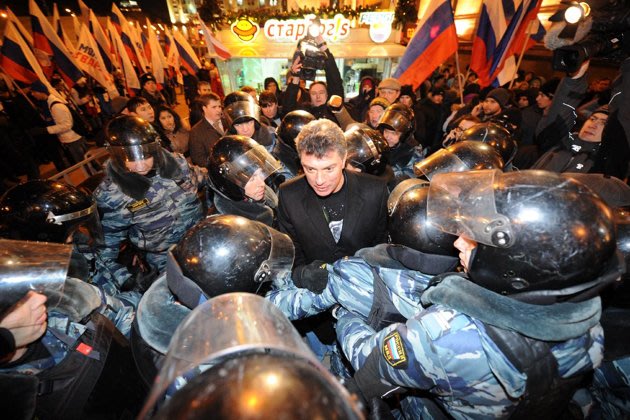
MOSCOW (AP) — Russian authorities should annul the results of the parliamentary vote and hold a new one, former Soviet leader Mikhail Gorbachev urged Wednesday as popular indignation grew over widespread allegations of election fraud.
The call for an entirely new vote by the last president of the Soviet Union was a remarkable development for an election that had not generated much interest during the campaign. Prime Minister Vladimir Putin had wanted to see his United Russia party do well to pave the way for his return to the presidency, but few Russians seemed to care about the vote, with many saying they assumed the results would be manipulated anyway.
United Russia won less than 50 percent of Sunday's vote, a steep fall from the 64 percent it won four years ago. But opposition parties and independent observers say even that result was inflated by vote-rigging, including alleged ballot-box stuffing and false voter rolls.
Gorbachev told the Interfax news agency that authorities must hold a fresh election or deal with a rising tide of discontent.
"More and more people are starting to believe that the election results are not fair," he told Interfax. "I believe that ignoring public opinion discredits the authorities and destabilizes the situation."
Surprisingly, thousands of Russians have rallied in Moscow and St. Petersburg in the last two days, facing off against tens of thousands of police and Interior Ministry troops. Hundreds of protesters have been detained in both cities. The unusually sustained protests suggests Putin's drive to regain his old job may not go as smoothly as he had expected.
The malaise revealed in Sunday's parliamentary election suggested Russians are tiring of Putin and his United Russia party, which has dominated all other political forces in Russia for the past dozen years and earned a reputation for corruption.
Gorbachev added that authorities "must admit that there have been numerous falsifications and ballot box stuffing."
He spoke on the same day that Putin officially registered to run for the presidency in a March vote.
Putin served as president from 2000 to 2008, when he moved into the prime minister's office because of a constitutional limit of two consecutive presidential terms. A constitutional amendment pushed through parliament by United Russia extended the presidential term from four to six years. Under it, Putin, 59, could theoretically serve as Russia's leader until 2024.
The 80-year-old Gorbachev, leader of the Soviet Union from 1985 until its breakup in 1991, has long had tense relations with Putin, but until recent years had refrained from directing his criticism of Russian politics at Putin.
Putin has been extremely critical of Gorbachev's legacy, including his concession to what many Russians saw as Western pressure to pull Soviet troops out of Germany, and has blamed him for the Soviet Union's demise.
Thousands of security forces were out in the Russian capital and helicopters roamed the sky Wednesday, a show of force following two days of protest. More opposition rallies were expected later in the day.
The Interior Ministry said Tuesday at least 51,500 police officers and 2,000 paramilitary troops have been deployed in Moscow since the election.
About 1,000 people gathered at a pro-Putin concert Wednesday afternoon in central Moscow. The crowd of mainly young people waved Russian flags and danced as organizers spoke on a stage adorned with a banner reading "The Future is Ours."
Someone dressed as a giant white bear — United Russia's mascot — danced among the crowd. He stopped occasionally to hug supporters — but kept right on dancing when someone ran out of the crowd to kick him in the rear.
College student Ivan Samburov, 17, said he had no interest in the protest rallies.
"I prefer just to stand like this and dance, to have fun and improve my mood, to feel that everything is good," he said.
The Russian Union of Journalists condemned police violence against protesters and called for an investigation into the dozens of attacks and arrests of journalists, describing them as "an attempt to gag and intimidate society."
On Wednesday, two video journalists working for the state-owned RIA Novosti news agency were briefly detained outside the Central Election Commission building where Putin was handing in his application to run.
The allegations of election fraud have fired up the opposition, which has long seen its protests crushed and its pleas ignored by the Kremlin-dominated media.
On Facebook, almost 15,000 people signed up to a page announcing an opposition rally for Saturday — and many of them have never taken part in political demonstrations
Mariya Boyarintseva, a 24-year-old event manager, said she has never been to a political rally before but she was going to Saturday's protest.
Boyarintseva said she didn't go to the rallies on Monday or Tuesday — which ended with clashes with police and hundreds detained — because "it felt a bit scary."
"Now, I have a feeling that I ought to go," she said.
Blagojevich gets 14 years in prison for corruption
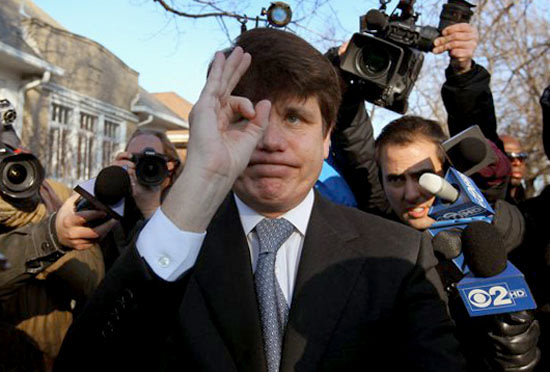
CHICAGO (AP) — Rod Blagojevich, the ousted Illinois governor whose three-year battle against criminal charges became a national spectacle, was sentenced to 14 years in prison Wednesday, one of the stiffest penalties imposed for corruption in a state with a history of crooked politics.
Among his 18 convictions is the explosive charge that he tried to leverage his power to appoint someone to President Barack Obama's vacated Senate seat in exchange for campaign cash or land a high-paying job.
Judge James Zagel gave Blagojevich some credit for taking responsibility for his actions — which the former governor did in an address to the court earlier in the day — but said that didn't mitigate his crimes. Zagel also said Blagojevich did good things for people as governor, but was more concerned about using his powers for himself.
"When it is the governor who goes bad, the fabric of Illinois is torn and disfigured and not easily repaired," Zagel said.
As the judge announced the sentence, which includes a $20,000 fine, Blagojevich hunched forward and his face appeared frozen. Minutes later, his wife, Patti Blagojevich, stood up and fell into her husband's arms. He pulled back to brush tears off her cheek and then rubbed her shoulders.
On his way out of the courthouse, Blagojevich cited author Rudyard Kipling and said it was a time to be strong, to fight through adversity and be strong for his children. He said he and wife were heading home to speak to their daughters, and then left without answering any questions.
The twice-elected Democrat received by far the harshest sentence among the four Illinois governors sent to prison in the last four decades. He is the second in a row to go to prison; his Republican predecessor, George Ryan, currently is serving 6 1/2 years. The other two got three years or less.
Blagojevich, in a last plea for mercy, tried something he never had before: an apology. After years of insisting he was innocent, he told the judge he'd made "terrible mistakes" and acknowledged that he broke the law.
"I caused it all, I'm not blaming anybody," Blagojevich said. "I was the governor and I should have known better and I am just so incredibly sorry."
But Zagel gave him little leeway.
"Whatever good things you did for people as governor, and you did some, I am more concerned with the occasions when you wanted to use your powers ... to do things that were only good for yourself," Zagel said.
The judge said he did not believe Blagojevich's contention, as his lawyers wrote in briefings, that his comments about the corruption schemes were simply "musings." Zagel said the jury concluded and he agreed that Blagojevich was engaged in actual schemes, and the undeniable leader of those schemes.
"The governor was not marched along this criminal path by his staff," Zagel said. "He marched them."
Prosecutors had asked for a sentence of 15 to 20 years, which Blagojevich's attorneys said was too harsh. The defense also presented heartfelt appeals from Blagojevich's family, including letters from his wife and one of his two daughters that pleaded for mercy.
But the judge made it clear early in the hearing that he believed that Blagojevich had lied on the witness stand when he tried to explain his scheming for the Senate seat, and he did not believe defense suggestions that the former governor was duped by his advisers.
The 54-year-old was ordered to begin serving his sentence on Feb. 16. In white-collar cases, convicted felons are usually given at least a few weeks to report to prison while federal authorities select a suitable facility. Blagojevich is expected to appeal his conviction, but it is unlikely to affect when he reports to prison.
Most of the prisons where Blagojevich could end up are outside Illinois. One is in Terre Haute, Ind., where Ryan is serving his own sentence. In prison, Blagojevich will largely be cut off from the outside world. Visits by family are strictly limited, Blagojevich will have to share a cell with other inmates and he must work an eight-hour-a-day menial job — possibly scrubbing toilets or mopping floors — at just 12 cents an hour.
According to federal rules, felons must serve at least 85 percent of the sentence a judge imposes — meaning Blagojevich wouldn't be eligible for early release until he serves nearly 12 years.
Going into the sentencing, many legal experts said the governor — who became a national punch line while doing reality TV appearances such as "Celebrity Apprentice" while his legal case unfolded — was likely to get around 10 years. A former Blagojevich fundraiser, Tony Rezko, recently was sentenced to 10 1/2 years, minus time served.
Prosecutors have said Blagojevich misused the power of his office "from the very moment he became governor." He was initially elected in 2002 on a platform of cleaning up Illinois politics in the midst of federal investigations that led to the prosecution and conviction of Ryan.
Defense attorneys have said Blagojevich has already paid a price in public ridicule and financial ruin, and had proposed a term of just a few years.
Blagojevich's sentencing came just days before his 55th birthday on Saturday, and nearly three years to the day of his arrest at dawn on Dec. 9, 2008, when the startled governor asked one federal agent, "Is this a joke?" In a state where corruption has been commonplace, images of Blagojevich being led away in handcuffs still came as a shock.
It took two trials for prosecutors to snare Blagojevich. His first ended deadlocked with jurors agreeing on just one of 24 counts — that Blagojevich lied to the FBI. Jurors at his retrial convicted him on 17 of 20 counts, including bribery and attempted extortion.
FBI wiretap evidence proved decisive. In the most notorious recording, Blagojevich is heard crowing that his chance to name someone to Obama's seat was "f---ing golden" and he wouldn't let it go "for f---ing nothing."
Blagojevich clearly dreaded the idea of prison time. Asked in an interview before his retrial about whether he dwelled on that prospect, he answered: "No. I don't let myself go there."
In the same interview, Blagojevich also explained that the family dog Skittles was bought after his arrest in to help his school-age daughters, Amy and Annie, cope with the stress of his legal troubles. He said he joked with them that, "If the worst happens (and I go to prison), you can get another dog and call him 'Daddy.'"
Subscribe to:
Posts (Atom)