
Just a heads up for everyone regarding the latest in Visa fraud. Royal Bank received this communication about the newest scam. This is happening in the Midwest right now and moving.
This one is pretty slick since they provide YOU with all the information, except the one piece they want..
Note, the callers do not ask for your card number; they already have it.
This information is worth reading. By understanding how the VISA & MasterCard telephone Credit Card Scam works, you'll be better prepared to protect yourself. One of our employees was called on Wednesday from 'VISA', and I was called on Thursday from 'MasterCard'.
The scam works like this:
Person calling says - 'This is (name), and I'm calling from the Security and Fraud Department at VISA. My Badge number is 12460, Your card has been flagged for an unusual purchase pattern, and I'm calling to verify. This would be on your VISA card which was issued by (name of bank). Did you purchase an Anti-Telemarketing Device for $497.99 from a marketing company based in Arizona ?' When you say 'No', the caller continues with, 'Then we will be issuing a credit to your account. This is a company we have been watching and the charges range from $297 to $497, just under the $500 purchase pattern that flags most cards. Before your next statement, the credit will be sent to (gives you your address), is that correct?' You say 'yes'.
The caller continues - 'I will be starting a Fraud Investigation. If you have any questions, you should call the 1- 800 number listed on the back of your card (1-800-VISA) and ask for Security. You will need to refer to this Control Number. The caller then gives you a 6 digit number. 'Do you need me to read it again?'
Here's the IMPORTANT part on how the scam works - The caller then says, 'I need to verify you are in possession of your card'. He'll ask you to 'turn your card over and look for some numbers'. There are 7 numbers; the first 4 are part of your card number, the last 3 are the Security Numbers that verify you are the possessor of the card. These are the numbers you sometimes use to make Internet purchases to prove you have the card. The caller will ask you to read the last 3 numbers to him. After you tell the caller the 3 numbers, he'll say, 'That is correct, I just needed to verify that the card has not been lost or stolen, and that you still have your card Do you have any other questions?'
After you say no, the caller then thanks you and states, 'Don't hesitate to call back if you do', and hangs up. You actually say very little, and they never ask for or tell you the card number. But after we were called on Wednesday, we called back. Within 20 minutes to ask a question. Are we were glad we did! The REAL VISA Security Department told us it was a scam and in the last 15 minutes a new purchase of $497.99 was charged to our card. We made a real fraud report and closed the VISA account. VISA is reissuing us a new number.. What the scammers want is the 3-digit PIN number on the back of the card. Don't give it to them. Instead, tell them you'll call VISA or Master Card directly for verification of their conversation..
The real VISA told us that they will never ask for anything on the card as they already know the information since they issued the card! If you give the scammers your 3 Digit PIN Number, you think you're receiving a credit; however, by the time you get your statement you'll see charges for purchases you didn't make, and by then it's almost too late and/or more difficult to actually file a fraud report.
What makes this more remarkable is that on Thursday, I got a call from a 'Jason Richardson of MasterCard' with a word-for-word repeat of the VISA Scam. This time I didn't let him finish. I hung up! We filed a police report, as instructed by VISA. The police said they are taking several of these reports daily! They also urged us to tell everybody we know that this scam is happening. I dealt with a similar situation this morning, with the caller telling me that $3,097 had been charged to my account for plane tickets to Spain , and so on through the above routine..
It appears that this Is a very active scam, and evidently quite successful.
Pass this on to all your family and friends
Saturday, November 12, 2011


Wednesday, November 9, 2011
Death threats for Boateng over his Ghana exit

AC Milan midfielder Kevin Prince Boateng has received death threats on Twitter in the wake of his decision to retire from the Ghana national team.
A tidal wave of hatred and anger were directed at the German-born player on social media websites on Friday after the decision became public.
The ex-Germany youth international switched nationality last year to play for the Black Stars when his career was going nowhere with relegated English side Portsmouth.
He gained entry into the Black Stars squad just before the World Cup in South Africa and after the team reached the quarter-finals he landed a lucrative deal with Italian giants AC Milan.
The 24-year-old’s decision came just two months before the Africa Cup of Nations and has been receiving threatening messages from irate Black Stars fans unhappy at his decision to quit.
A twitter user wrote on Boateng’s account: “The next time u come to Ghana….wait don’t even THINK about coming or else we’ll slaughter you!!!”
“Prince Boateng go and ask John Mensah how he had to sneak back into Ghana after that his penalty miss,” a female on twitter also threatened.
The hatred and fury, which was also well captured on Facebook, saw fans raining curses on the player with many wishing Boateng career threatening injuries.
Some insults were also poured on the AC Milan star with the most offensive words – which are unprintable.
He won nine Ghanacaps and scored one goal.
Boateng’s only international goal came in the 2-1 win over the United States at the second round of the World Cup in South Africa last year.
The news comes as a blow for Ghana who are seeking to win the Africa Cup of Nations in Gabon and Equatorial Guinea in January
But the decision doesn’t leave the Black Stars short of midfield options as youngsters Emmanuel Agyemang Badu, Kwadwo Asamoah, Andre Ayew as well as Michael Essien and Sulley Muntari are still available for the national team.
Tuesday, November 8, 2011
Asleep In The Cockpit
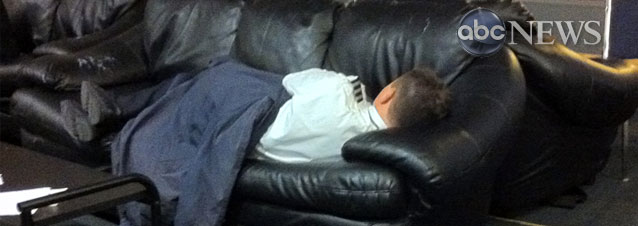
Despite denials from the airline industry, large numbers of pilots report to duty every day after getting only a few hours of what fatigue experts call "destructive sleep" in crowded crew lounges and so-called "crash pads," an ABC News investigation has found. Widespread pilot fatigue is putting airline passengers at risk, say critics, and may already have cost lives.
Current and former pilots described missing radio calls, entering incorrect readings in instruments and even falling asleep in mid-flight in the report to be broadcast tonight on "World News with Diane Sawyer" and "Nightline".
Former Continental Express pilot Josh Reikes says one captain warned him, "Don't you ever let me wake up and find you sleeping."
America's most famous pilot, Captain Chesley "Sully" Sullenberger, doubts he could have landed his stricken U.S. Airways jet safely in the Hudson River, saving all 155 people aboard, if he had been sleep-deprived.
"Had we been tired, had we not gotten sufficient rest the night before," said Sullenberger, "we could not have performed at the same level."
Sullenberger says fatigue is an industry-wide problem that "needs to be fixed, and has needed to be fixed for 30 years."
"We have to create a situation in which it's possible" for pilots to get a good, affordable night's sleep, he said. "We have to value this profession enough that people don't have to live out of a crash pad or a crew room."
Dr. Martin Moore-Ede, a fatigue expert who consults for airlines, unions and the government, said that it would be hard for pilots to get adequate rest in the kinds of places where many try to sleep.
Israeli Prime Minister Is a Liar, French President Tells Obama
French President Sarkozy called Israeli Prime Minister Netanyahu a liar in a conversation with President Obama caught on an open mic at last week's G-20 summit.
"I can't look at him [Netanyahu] anymore, he's a liar," Sarkozy told Obama, the French media website Arret Sur Images reported.
"You've had enough of him, but I have to deal with him every day," Obama is said to have responded.
The private conversation happened last Thursday in the southern French city of Cannes, heard by half a dozen journalists whose headphones were still receiving audio from the presidents' wireless microphones.
The handful of reporters included one from the Reuters news agency who confirmed the quotes.
"By the time the team from the Elysee [presidential palace] realized, it must have been three minutes," one of the journalists told Arret Sur Images.
Reporters who overheard the remarks decided not to report them because they were intended to be private, but the news leaked out on the Internet nonetheless.
"We didn't record anything and using them [the comments] would admit that we cheated," an anonymous reporter told the website.
It also quoted another member of the media saying, "there were discussions among the journalists there who decided not to do anything. It's a sensitive subject: it's annoying to not publish this information, but at the same time we have agreed to precise ethical rules and printing these sentences would mean violating them."
Netanyahu's office declined ABC News' request for comment and the White House has yet to respond.
Sarkozy and Obama were discussing the recent admission of Palestine to UNESCO, part of its bid to get recognition at the United Nations. The U.S. opposes the Palestinian efforts and Obama was reportedly chiding Sarkozy for not telling him France would vote in favor of Palestine in the UNESCO vote. The U.S. later withdrew its funding for the cultural body which amounts to $70 million annually.
The conversation then turned to Netanyahu, which is when Sarkozy is said to have called him a liar.
At least publicly, the three countries are united on the issue of the day: crippling sanctions for Iran when the International Atomic Energy Agency releases its latest report this week.
Though Iran was the top story in the Israeli media on Tuesday, the main newspapers also ran the Arret Sur Images report.
The Jerusalem Post reported that a spokesman for the opposition party Kadima -- whose last campaign slogan was "Bibi [Netanyahu's nickname], I don't believe him" -- declined to comment, saying, "What Sarkozy said is more than enough."
"I can't look at him [Netanyahu] anymore, he's a liar," Sarkozy told Obama, the French media website Arret Sur Images reported.
"You've had enough of him, but I have to deal with him every day," Obama is said to have responded.
The private conversation happened last Thursday in the southern French city of Cannes, heard by half a dozen journalists whose headphones were still receiving audio from the presidents' wireless microphones.
The handful of reporters included one from the Reuters news agency who confirmed the quotes.
"By the time the team from the Elysee [presidential palace] realized, it must have been three minutes," one of the journalists told Arret Sur Images.
Reporters who overheard the remarks decided not to report them because they were intended to be private, but the news leaked out on the Internet nonetheless.
"We didn't record anything and using them [the comments] would admit that we cheated," an anonymous reporter told the website.
It also quoted another member of the media saying, "there were discussions among the journalists there who decided not to do anything. It's a sensitive subject: it's annoying to not publish this information, but at the same time we have agreed to precise ethical rules and printing these sentences would mean violating them."
Netanyahu's office declined ABC News' request for comment and the White House has yet to respond.
Sarkozy and Obama were discussing the recent admission of Palestine to UNESCO, part of its bid to get recognition at the United Nations. The U.S. opposes the Palestinian efforts and Obama was reportedly chiding Sarkozy for not telling him France would vote in favor of Palestine in the UNESCO vote. The U.S. later withdrew its funding for the cultural body which amounts to $70 million annually.
The conversation then turned to Netanyahu, which is when Sarkozy is said to have called him a liar.
At least publicly, the three countries are united on the issue of the day: crippling sanctions for Iran when the International Atomic Energy Agency releases its latest report this week.
Though Iran was the top story in the Israeli media on Tuesday, the main newspapers also ran the Arret Sur Images report.
The Jerusalem Post reported that a spokesman for the opposition party Kadima -- whose last campaign slogan was "Bibi [Netanyahu's nickname], I don't believe him" -- declined to comment, saying, "What Sarkozy said is more than enough."
Arrests of illegal miners amount to ‘state terrorism’ - NPP’s Kweku Kwarteng

An aspiring parliamentary candidate of the NPP for the Obuasi constituency, Kweku Kwarteng, has described the arrests of some 150 illegal miners in that constituency as an act of “state terrorism”.
Some national security operatives last Friday organised a swoop at a galamsey site and arrested 150 small scale miners believed to be indulging in an illegal activity referred to as galamsey.
Some of the other miners picketed at the premises of Anglogold Ashanti in Obuasi, demanding the release of their colleagues who had been arrested. The confrontation between the miners and security operatives led to the police firing tear gas to disperse the crowd.
In an interview with Citi News, Mr. Kwarteng said “my immediate responds is that what happened in Obuasi last Friday was nothing but state terrorism. ”
"Galamsey activities that are not legitimate we condemn, but our position is that if any galamsey operator offends the law, let the law do its work.
“To bring armed security personnel to Obuasi, and roundup young men you see around because you have an issue against galamsey is state terrorism. We have seen this in Obuasi before,” he stated.
Kwarteng added: "In 1979 under Mr. [JJ] Rawlings, soldiers invaded this community and rounded up anybody who was considered to be a rich man and said these were gold dealers, strip them naked and asked some of them to lie on the floor and pretend as though they were sleeping with their wives.
“President Mills was in the Eastern region after the floods and what he said was that this is time to wage war on galamsey. That is what happened here and we are cautioning the President that if he continues to do this what we’d witness is what we witnessed last Friday. ”
"People rising up to confront the security agencies, is that what we really want? ” he queried."We want peace and common sense approach towards solutions not actions which may inflame tempers to create this type of scenario"
Calm is said to have returned to Obuasi after 62 of the 150 illegal miners were released on Sunday.
Monday, November 7, 2011
Families of Ghanaian hostage appeals to Prez
The family of a Ghanaian who is being held hostage together with others by Somalian pirates is appealing to President Mills to urgently intervene and secure their release.
Mr Francis Koomson, 58, and his compatriots Jewel Ahiable, Prince John Agbo and Edward Kofi Asare, together with 18 other people of Indian, Pakistani and Yemen nationalities who were captured on March 29, 2010, feared they could be executed any moment if the government failed to negotiate with the group on the $1 million demand being made for their release.
A desperate Koomson, who is being used as a spokesperson for the four Ghanaians, told the Daily Graphic in a telephone interview that “hope is running out for us”. He said as the vessel was also taking in water and their captors were threatening to execute them and abandon the vessel whose owner had declined to pay $8 million being demanded by the pirates for its release.
In a frail voice, he told the Daily Graphic that the conditions under which they were being held kept deteriorating.
“I can’t walk or move around since my legs are swollen. Besides, the cabin in which we are being kept is an unventilated one, thus compounding our woes,” he said sobbing.
Mr Koomson said their captors needed the assurance from the government that it would negotiate for their release, saying, “if only we can get a government official to speak to these people, 1 am sure our lives would be spared”.
The 24 crew members on board the RORO vessel, MV Iceberg, were captured within the Somali waters while travelling to Dubai from Oman in the Middle East where they had gone to deliver goods in March, 2010.
An Indian national who could not stand the ordeal was reported' to have committed suicide, while a Pakistani was killed by the pirates to send home their message to the crew.
A 28-year-old son of Mr Koomson, Francis Koomson Junior, who accompanied family members to the offices Of the Daily Graphic, said that although the Foreign Minister, Mr Mohammed Mumuni and the National Security Co-ordinator, Mr Larry Gbevlo Lartey, held a meeting with the family and officials of the Immigration Service and the Customs Division of the Ghana Revenue Authority (GRA) sometime in 2010, when the incident first occurred, nothing had been heard from them.
“Several attempts to subsequently meet the minister and Mr Lartey have been unsuccessful,” he said.
A visibly worried Koomson Junior said he feared the fate of his father hung in the balance since the family had no idea as to how to raise the $l million being demanded by the group, of captors and appealed to public-spirited Ghanaians to join in their plea for the President's intervention.
Mr Francis Koomson, 58, and his compatriots Jewel Ahiable, Prince John Agbo and Edward Kofi Asare, together with 18 other people of Indian, Pakistani and Yemen nationalities who were captured on March 29, 2010, feared they could be executed any moment if the government failed to negotiate with the group on the $1 million demand being made for their release.
A desperate Koomson, who is being used as a spokesperson for the four Ghanaians, told the Daily Graphic in a telephone interview that “hope is running out for us”. He said as the vessel was also taking in water and their captors were threatening to execute them and abandon the vessel whose owner had declined to pay $8 million being demanded by the pirates for its release.
In a frail voice, he told the Daily Graphic that the conditions under which they were being held kept deteriorating.
“I can’t walk or move around since my legs are swollen. Besides, the cabin in which we are being kept is an unventilated one, thus compounding our woes,” he said sobbing.
Mr Koomson said their captors needed the assurance from the government that it would negotiate for their release, saying, “if only we can get a government official to speak to these people, 1 am sure our lives would be spared”.
The 24 crew members on board the RORO vessel, MV Iceberg, were captured within the Somali waters while travelling to Dubai from Oman in the Middle East where they had gone to deliver goods in March, 2010.
An Indian national who could not stand the ordeal was reported' to have committed suicide, while a Pakistani was killed by the pirates to send home their message to the crew.
A 28-year-old son of Mr Koomson, Francis Koomson Junior, who accompanied family members to the offices Of the Daily Graphic, said that although the Foreign Minister, Mr Mohammed Mumuni and the National Security Co-ordinator, Mr Larry Gbevlo Lartey, held a meeting with the family and officials of the Immigration Service and the Customs Division of the Ghana Revenue Authority (GRA) sometime in 2010, when the incident first occurred, nothing had been heard from them.
“Several attempts to subsequently meet the minister and Mr Lartey have been unsuccessful,” he said.
A visibly worried Koomson Junior said he feared the fate of his father hung in the balance since the family had no idea as to how to raise the $l million being demanded by the group, of captors and appealed to public-spirited Ghanaians to join in their plea for the President's intervention.
More oil spills to be expected on Ghana’s coasts – report

The Daily Graphic newspaper reports that there is the possibility of more oil spills on Ghana’s coastlines. The newspaper attributes the possibility to the absence of an offshore vessel monitoring system and appropriate laws to sanction offenders.
The publication citing an unnamed source at the Ghana Maritime Academy (GMA) said the absence of the equipment; Vessel Traffic Moitoring Information System (VTMIS) which could record second by second activities of vessels calling at the country’s ports or passing through the country’s territorial waters, would continue to make the practice attractive to vessels which found dumping cheaper, if not caught than legal disposal.
The source told the Daily Graphic that with the rise in vessel traffic in the country’s ports and the supply services to suppport offshore and oil and gas operations, the VTMIS was crucial and should be procured to save the country’s coastlines.
The source according to the publication cited a vessel, Spirit River which dumped toxic waste at Essipon in the Western Region early this year and was fined a mere $258,000 in penalties.
The source also told the newspaper that there have been several other spills which formed star-balls that polluted the beaches of Jomoro and Ellembelle in the Nzema area.
The source indicated that, it is only the VTMIS that could have given information on the specific vessel that caused the pollution. “Without the VTMIS, it would be difficult to get the particular vessel,” the source said.
Since Ghana announced discovery of oil in commercial quantities in 2007 and started commercial production in December 2010, various individuals and civil society groups have raised concern about the country’s readiness to deal with the challenges that come with being an oil producing country, often citing Nigeria’s Niger Delta as an example to take a cue from and learn to avoid the downsides of oil and gas production which include environmental pollution and threat to local communities’ sources of livelihood.
By Emmanuel K. Dogbevi
GBN
.........
Sunday, November 6, 2011
Nigeria pirates release oil tanker seized last week
LAGOS (Reuters) - Pirates have released an oil tanker and its crew they seized off the coast of Nigeria a week ago, the Nigeria Maritime Administration said on Saturday, the latest in a string of attacks on ships in the oil-rich Gulf of Guinea.
Contact was lost with the crew of the Halifax, an oil products tanker managed by Greece-based Ancora Investment Trust Inc, around the time it was hijacked last weekend. An official said it was located 60 miles (97 kms) off the coast Port Harcourt before it was hijacked.
Experts say recent attacks on ships in the Gulf of Guinea threaten the region's position as an emerging trade hub which is an increasingly important source of oil, metals and agricultural products such as cocoa to world markets.
"Halifax was reportedly located this morning off Bonny Fairway buoy. The vessel is presently being escorted to Port Harcourt harbour by Nigerian Navy Patrol Team. Further details to follow," read an email message sent to Reuters by the Nigeria Maritime Administration spokeswoman Lami Tumaka.
Pirates in the Gulf of Guinea, which stretches from Guinea to Angola, tend to raid ships for cash and cargo rather than hijacking the crews for ransom like their counterparts off the coast of Somalia, analysts say.
The frequency of attacks, while not as high as off the Somali coast or surrounding Indian Ocean, is on the rise. Earlier this month, pirates hijacked a chemical product tanker and kidnapped the crew off the Nigerian coast.
Contact was lost with the crew of the Halifax, an oil products tanker managed by Greece-based Ancora Investment Trust Inc, around the time it was hijacked last weekend. An official said it was located 60 miles (97 kms) off the coast Port Harcourt before it was hijacked.
Experts say recent attacks on ships in the Gulf of Guinea threaten the region's position as an emerging trade hub which is an increasingly important source of oil, metals and agricultural products such as cocoa to world markets.
"Halifax was reportedly located this morning off Bonny Fairway buoy. The vessel is presently being escorted to Port Harcourt harbour by Nigerian Navy Patrol Team. Further details to follow," read an email message sent to Reuters by the Nigeria Maritime Administration spokeswoman Lami Tumaka.
Pirates in the Gulf of Guinea, which stretches from Guinea to Angola, tend to raid ships for cash and cargo rather than hijacking the crews for ransom like their counterparts off the coast of Somalia, analysts say.
The frequency of attacks, while not as high as off the Somali coast or surrounding Indian Ocean, is on the rise. Earlier this month, pirates hijacked a chemical product tanker and kidnapped the crew off the Nigerian coast.
MPs, Clergy Hail Mills For His Stance On Homosexuality
Members of Parliament Thursday took their turn on the ongoing debate on homosexuality and condemned attempt by the British Prime Minister, Mr David Cameron, to coerce the country to legalise same-sex practices.
The issue arose on the floor of the House, following a statement made by the MP for Ablekuma North, Mr Joe Appiah, during which he stated that the insurgence of the practice had brought back the ancient phenomenon that had been swept under the carpet probably for fear of offending the gay and lesbian movements that were fast gaining grounds recently.
His statement also comes on the heels of President John Evans Atta Mills’s declaration on Wednesday, that under no circumstances would Ghana kowtow to demands to respect the rights of gays and lesbians.
In his statement, Mr Appiah noted that traditions and cultures of all tribes in Ghana had no respect for gays and lesbians, pointing out that this was why such behaviour was condemned and the culprits ostracised even in prehistoric days.
He stated that today sexually transmitted diseases had assumed alarming rate and morality was fast declining and attributed these to the insurgence of homosexuality in the country.
Mr Appiah called on religious leaders to use their pulpits to educate members of their congregation to uphold the principles of morality and integrity.
Contributing to the statement, the MP for Asawase, Alhaji Muntaka Mohammed Mubarak, thanked both the President and his colleagues for coming out forcefully to state the minds of Ghanaians on the issue at the right time.
For his part, the MP for Sekondi, Papa Owusu-Ankomah, said he had no doubt in his mind that all tribes in Ghana abhored the practice of homosexuality.
He said it was unfortunate that with time Ghanaians had compromised their cultural values based on the values of other people.
Papa Owusu-Ankomah stated that it was for that reason that in recent times Ghana had been advertised as a nation full of social deviants.
He said MPs were resolved in their conviction that homosexuality was unacceptable and commended the President for making a statement on the issue.
“As the President of the country, his statement has confirmed the deep seated sentiments of the people,” he said, explaining that the act went contrary to the principle of creation.
The MP for New Juaben North, Mr Hackman Owusu-Agyeman, stated that even though the practice must be condemned, people should rather comment on the issues without insulting people who supported homosexuality.
The Second Deputy Speaker and MP for Dome-Kwabenya, Professor Mike Oquaye, described homosexuality as “abominable”.
Holding a lot of British newspapers in his hands, he stated that most homes in Britain were in ruins as a result of the persistent attacks on the country’s social fabric and called on Ghanaians to guard against their cherished cultural norms and values that had bounded them as a people with a common destiny.
The Majority Leader, Mr Cletus Avoka, referred Ghanaians to Article 11 of the Constitution and stated that anything that was considered an affront to the country’s culture was unconstitutional.
Other MPs who contributed to the statement were the Minority Leader, Mr Osei Kyei-Mensah-Bonsu; Mrs Gifty Ohene Konadu, MP for Asante Akim South; Mr Theophilus Tetteh Chaie, MP for Ablekuma Central, and MP for Tarkwa-Nsuaem, Mrs Gifty Kusi.
In a related development, some religious leaders in Ghana have applauded President J. E. A. Mills for his bold stance against homosexuality and urged Ghanaians to resist any imposition of Western culture on the country, reports Kofi Yeboah.
They, however, stressed the need to go beyond the President’s comments by enacting legislation that would explicitly outlaw the practice of homosexuality in Ghana.
The religious leaders who spoke to the Daily Graphic in separate interviews yesterday, were the Ameer and Missionary in charge of the Ahmadiyya Muslim Mission in Ghana, Maulvi Dr Wahab A. Adam; the General Secretary of the Ghana Pentecostal and Charismatic Council, Apostle Samuel Yaw Antwi, and the President of the Evangelical Lutheran Church of Ghana, Rt. Rev. Dr Paul Kofi Fynn
Their remarks follow the response made by President Mills to British Prime Minister David Cameron’s threat to cut British aid to African countries that do not promote gay rights.
Religious bodies in the country have been waging a strong campaign against the practice of homosexuality, including public pronouncements denouncing the practice and education campaigns to sensitise people to it.
Maulvi Dr Adam said the President’s comments were a step in the right direction because “no independent country worth its salt, should take dictation about moral rights from another country”.
He said homosexuality was condemned by both the Christian and Muslim faith, and considering the fact that Christians and Muslims constituted the majority of the Ghanaian population, the President could not have acted differently.
Maulvi Dr Adam said it was unfortunate for the British Prime Minister to use aid as a condition to attempt to impose values that were alien and offensive to the country’s moral code.
While denouncing homosexuality, he said there was the need for Ghana to become self-supporting in order to avoid foreign aid and their conditions.
“There is no reason why after 50 years of independence, we should still be begging for alms,” he said, adding that it was important for Ghanaians to work hard to ensure that the nation became self-supporting.
For his part, Apostle Antwi said President Mills’s comments reflected the concerns of the entire nation against homosexuality and gave a clear position of the government on the matter.
He said it was important to go a step further by enacting legislation to outlaw homosexuality in the country..
Sharing his thoughts on the matter, the Rt. Rev. Dr Fynn described President Mills’s comments as “perfect and spot on”, adding, “There is no way Ghanaians should allow anyone to impose anything on them.”
He said the Bible did not support homosexuality, and so he endorsed any effort to legislate against the practice of homosexuality.
Although he concedes that the law may not address the problem entirely, he contended that it would help reduce the phenomenon.
In a contrary opinion however, the General Secretary of the Christian Council of Ghana, Rev. Dr Fred Deegbe, contended that education was a preferred option to the law in dealing with the issue.
Taking a different stance on the use of the law to address the practice of homosexuality, Rev Dr Deegbe said “you cannot legislate morality and expect all to abide by it”.
He observed that some countries had gone that path but they had not succeeded in addressing the problem, adding that there was the need for education and show of compassion for people who indulged in homosexuality.
He said the comments made by David Cameron were almost an intimidation which ought to be resisted by all Ghanaians and in the manner President Mills did.
Rev Dr Deegbe said the Church recognised the serious health effects emanating from the practice of homosexuality, adding that the cost of endorsing the practice far outweighed the benefit of foreign aid from Britain.
The issue arose on the floor of the House, following a statement made by the MP for Ablekuma North, Mr Joe Appiah, during which he stated that the insurgence of the practice had brought back the ancient phenomenon that had been swept under the carpet probably for fear of offending the gay and lesbian movements that were fast gaining grounds recently.
His statement also comes on the heels of President John Evans Atta Mills’s declaration on Wednesday, that under no circumstances would Ghana kowtow to demands to respect the rights of gays and lesbians.
In his statement, Mr Appiah noted that traditions and cultures of all tribes in Ghana had no respect for gays and lesbians, pointing out that this was why such behaviour was condemned and the culprits ostracised even in prehistoric days.
He stated that today sexually transmitted diseases had assumed alarming rate and morality was fast declining and attributed these to the insurgence of homosexuality in the country.
Mr Appiah called on religious leaders to use their pulpits to educate members of their congregation to uphold the principles of morality and integrity.
Contributing to the statement, the MP for Asawase, Alhaji Muntaka Mohammed Mubarak, thanked both the President and his colleagues for coming out forcefully to state the minds of Ghanaians on the issue at the right time.
For his part, the MP for Sekondi, Papa Owusu-Ankomah, said he had no doubt in his mind that all tribes in Ghana abhored the practice of homosexuality.
He said it was unfortunate that with time Ghanaians had compromised their cultural values based on the values of other people.
Papa Owusu-Ankomah stated that it was for that reason that in recent times Ghana had been advertised as a nation full of social deviants.
He said MPs were resolved in their conviction that homosexuality was unacceptable and commended the President for making a statement on the issue.
“As the President of the country, his statement has confirmed the deep seated sentiments of the people,” he said, explaining that the act went contrary to the principle of creation.
The MP for New Juaben North, Mr Hackman Owusu-Agyeman, stated that even though the practice must be condemned, people should rather comment on the issues without insulting people who supported homosexuality.
The Second Deputy Speaker and MP for Dome-Kwabenya, Professor Mike Oquaye, described homosexuality as “abominable”.
Holding a lot of British newspapers in his hands, he stated that most homes in Britain were in ruins as a result of the persistent attacks on the country’s social fabric and called on Ghanaians to guard against their cherished cultural norms and values that had bounded them as a people with a common destiny.
The Majority Leader, Mr Cletus Avoka, referred Ghanaians to Article 11 of the Constitution and stated that anything that was considered an affront to the country’s culture was unconstitutional.
Other MPs who contributed to the statement were the Minority Leader, Mr Osei Kyei-Mensah-Bonsu; Mrs Gifty Ohene Konadu, MP for Asante Akim South; Mr Theophilus Tetteh Chaie, MP for Ablekuma Central, and MP for Tarkwa-Nsuaem, Mrs Gifty Kusi.
In a related development, some religious leaders in Ghana have applauded President J. E. A. Mills for his bold stance against homosexuality and urged Ghanaians to resist any imposition of Western culture on the country, reports Kofi Yeboah.
They, however, stressed the need to go beyond the President’s comments by enacting legislation that would explicitly outlaw the practice of homosexuality in Ghana.
The religious leaders who spoke to the Daily Graphic in separate interviews yesterday, were the Ameer and Missionary in charge of the Ahmadiyya Muslim Mission in Ghana, Maulvi Dr Wahab A. Adam; the General Secretary of the Ghana Pentecostal and Charismatic Council, Apostle Samuel Yaw Antwi, and the President of the Evangelical Lutheran Church of Ghana, Rt. Rev. Dr Paul Kofi Fynn
Their remarks follow the response made by President Mills to British Prime Minister David Cameron’s threat to cut British aid to African countries that do not promote gay rights.
Religious bodies in the country have been waging a strong campaign against the practice of homosexuality, including public pronouncements denouncing the practice and education campaigns to sensitise people to it.
Maulvi Dr Adam said the President’s comments were a step in the right direction because “no independent country worth its salt, should take dictation about moral rights from another country”.
He said homosexuality was condemned by both the Christian and Muslim faith, and considering the fact that Christians and Muslims constituted the majority of the Ghanaian population, the President could not have acted differently.
Maulvi Dr Adam said it was unfortunate for the British Prime Minister to use aid as a condition to attempt to impose values that were alien and offensive to the country’s moral code.
While denouncing homosexuality, he said there was the need for Ghana to become self-supporting in order to avoid foreign aid and their conditions.
“There is no reason why after 50 years of independence, we should still be begging for alms,” he said, adding that it was important for Ghanaians to work hard to ensure that the nation became self-supporting.
For his part, Apostle Antwi said President Mills’s comments reflected the concerns of the entire nation against homosexuality and gave a clear position of the government on the matter.
He said it was important to go a step further by enacting legislation to outlaw homosexuality in the country..
Sharing his thoughts on the matter, the Rt. Rev. Dr Fynn described President Mills’s comments as “perfect and spot on”, adding, “There is no way Ghanaians should allow anyone to impose anything on them.”
He said the Bible did not support homosexuality, and so he endorsed any effort to legislate against the practice of homosexuality.
Although he concedes that the law may not address the problem entirely, he contended that it would help reduce the phenomenon.
In a contrary opinion however, the General Secretary of the Christian Council of Ghana, Rev. Dr Fred Deegbe, contended that education was a preferred option to the law in dealing with the issue.
Taking a different stance on the use of the law to address the practice of homosexuality, Rev Dr Deegbe said “you cannot legislate morality and expect all to abide by it”.
He observed that some countries had gone that path but they had not succeeded in addressing the problem, adding that there was the need for education and show of compassion for people who indulged in homosexuality.
He said the comments made by David Cameron were almost an intimidation which ought to be resisted by all Ghanaians and in the manner President Mills did.
Rev Dr Deegbe said the Church recognised the serious health effects emanating from the practice of homosexuality, adding that the cost of endorsing the practice far outweighed the benefit of foreign aid from Britain.
US warns Nigerian extremists may target hotels in capital
An Islamist sect that carried out deadly bombings in the northeast of the country could next attack hotels and other targets in the capital Abuja, the US embassy in Nigeria warned Sunday.
"Following the recent Boko Haram, aka Nigerian Taliban, attacks in Borno and Yobe State, the US embassy has received information that Boko Haram may plan to attack several locations and hotels in Abuja," during the Eid al-Adha Muslim holiday, the embassy said in a statement.
Boko Haram, an Islamist sect based in the north of Africa's most populous country, carried out attacks that claimed 150 lives in the northeastern city Damaturu on Friday, one of the deadliest strikes ever staged by the group. Around 100 other people were injured in the attacks.
The US embassy said potential targets could include the Nicon Luxury, the Sheraton and the Transcorp Hilton, Abuja's premier hotels normally frequented by foreigners, Nigerian politicians and businessmen.
The statement said embassy staff had been told to avoid these hotels
"Following the recent Boko Haram, aka Nigerian Taliban, attacks in Borno and Yobe State, the US embassy has received information that Boko Haram may plan to attack several locations and hotels in Abuja," during the Eid al-Adha Muslim holiday, the embassy said in a statement.
Boko Haram, an Islamist sect based in the north of Africa's most populous country, carried out attacks that claimed 150 lives in the northeastern city Damaturu on Friday, one of the deadliest strikes ever staged by the group. Around 100 other people were injured in the attacks.
The US embassy said potential targets could include the Nicon Luxury, the Sheraton and the Transcorp Hilton, Abuja's premier hotels normally frequented by foreigners, Nigerian politicians and businessmen.
The statement said embassy staff had been told to avoid these hotels
Wednesday, November 2, 2011
Dream Big. Nana Tells Mills
THE NEW PATRIOTIC Party (NPP) Presidential Candidate, Nana Addo Danquah Akufo Addo, has described President Atta Mills as a 'confused' person who is presiding over a visionless, corrupt and inefficient government which doesn't bring hope to the future of Ghana.
Nana Akufo-Addo stated: 'Small minds with little visions don't build nations', adding that 'he is confident that with the right leadership, Ghana can be compared to the leading countries of the world.'
He said, 'The kind of future that the Ghanaian people aspire to cannot be attained by this visionless, incompetent and mediocre NDC government that is currently in office', adding that 'our energies have to be directed towards building a forward moving and progressive Ghana with an economy that can provide all our people with jobs, jobs and jobs.'
Nana Akufo Addo was addressing a huge gathering of party members and students of the Kwame Nkrumah University of Science and Technology (KNUST) in Kumasi on Monday evening to mark the 10 th anniversary of the KNUST branch of the Tertiary Education Confederacy Network of the NPP (TESCON) at the Great Hall.
He has therefore tasked the youth of the country to offer unflinching support to the NPP which he described as the 'best political party on the African continent' to unseat the NDC in the coming polls to take the country to the Promised Land.
As president, the former Foreign Affairs Minister in the Kufuor administration said, he would implement effective policies and mechanisms that would transform the country into a first world country, stressing, 'If the Asians, Japanese, Chinese and Malaysians could do it, Ghanaians could equally do it.'
He reiterated his determination to extend the free basic education brought by the President Kufuor regime to the senior high school level if he became the president, adding, Ghana would be transformed from a raw material-producing economy into a modern industrialized value-added economy during his presidency.
He jabbed his critics who claimed his vision was beyond the country, reminding them that 'the world today belongs to those who can think big, act big and do big things'.
'I know that when one throws a challenge like this, small minds with little visions will quickly say that it is just big talk, but the truth is that the world was not built by small minds with little vision,' he said.
He challenged the students to think big and also vote for leaders who had shown that they thought and acted big, adding that 'the NPP has shown that it is the only political force that has that big vision for Ghana.'
For his vision for the country to be realized, the NPP presidential candidate narrated that education would occupy the centre stage of his administration, stressing, Ghana would overcome the problems that had now gripped the country owing to bad leadership.
He said, 'We are not going to build a Ghana where some are left behind because their parents do not have the means. That is gross social injustice and we intend to cure that injustice by providing all our people with access to free, quality education.'
Nana Akufo-Addo noted that the NDC's 'Better Ghana Agenda' was not real, promising to make the 'Better Ghana' mantra a reality by bettering the lives of the citizenry when he was elected president in 2012.
The NPP presidential candidate stressed that the party needed to win the 2012 elections in order to wrest the country from the hands of 'incompetence, corruption and confusion' to make the people enjoy life.
The NPP, he pointed out, was not after political power to amass wealth and lord it over the electorate who gave them their mandate, but to serve and transform the country for the populace to benefit.
He said the vision of the NPP 'is development of Ghana in freedom,' noting that this could never be achieved unless the people gave the NPP their mandate to run the affairs of the country.
Among the NPP bigwigs that graced the event were former Chief of Staff Kwadwo Mpiani, NPP General Secretary Kwadwo Owusu-Afriyie, Alberta Owusu, Patricia Appiagyei, F.F. Anto and Kwabena Agyapong.
Nana Akufo-Addo stated: 'Small minds with little visions don't build nations', adding that 'he is confident that with the right leadership, Ghana can be compared to the leading countries of the world.'
He said, 'The kind of future that the Ghanaian people aspire to cannot be attained by this visionless, incompetent and mediocre NDC government that is currently in office', adding that 'our energies have to be directed towards building a forward moving and progressive Ghana with an economy that can provide all our people with jobs, jobs and jobs.'
Nana Akufo Addo was addressing a huge gathering of party members and students of the Kwame Nkrumah University of Science and Technology (KNUST) in Kumasi on Monday evening to mark the 10 th anniversary of the KNUST branch of the Tertiary Education Confederacy Network of the NPP (TESCON) at the Great Hall.
He has therefore tasked the youth of the country to offer unflinching support to the NPP which he described as the 'best political party on the African continent' to unseat the NDC in the coming polls to take the country to the Promised Land.
As president, the former Foreign Affairs Minister in the Kufuor administration said, he would implement effective policies and mechanisms that would transform the country into a first world country, stressing, 'If the Asians, Japanese, Chinese and Malaysians could do it, Ghanaians could equally do it.'
He reiterated his determination to extend the free basic education brought by the President Kufuor regime to the senior high school level if he became the president, adding, Ghana would be transformed from a raw material-producing economy into a modern industrialized value-added economy during his presidency.
He jabbed his critics who claimed his vision was beyond the country, reminding them that 'the world today belongs to those who can think big, act big and do big things'.
'I know that when one throws a challenge like this, small minds with little visions will quickly say that it is just big talk, but the truth is that the world was not built by small minds with little vision,' he said.
He challenged the students to think big and also vote for leaders who had shown that they thought and acted big, adding that 'the NPP has shown that it is the only political force that has that big vision for Ghana.'
For his vision for the country to be realized, the NPP presidential candidate narrated that education would occupy the centre stage of his administration, stressing, Ghana would overcome the problems that had now gripped the country owing to bad leadership.
He said, 'We are not going to build a Ghana where some are left behind because their parents do not have the means. That is gross social injustice and we intend to cure that injustice by providing all our people with access to free, quality education.'
Nana Akufo-Addo noted that the NDC's 'Better Ghana Agenda' was not real, promising to make the 'Better Ghana' mantra a reality by bettering the lives of the citizenry when he was elected president in 2012.
The NPP presidential candidate stressed that the party needed to win the 2012 elections in order to wrest the country from the hands of 'incompetence, corruption and confusion' to make the people enjoy life.
The NPP, he pointed out, was not after political power to amass wealth and lord it over the electorate who gave them their mandate, but to serve and transform the country for the populace to benefit.
He said the vision of the NPP 'is development of Ghana in freedom,' noting that this could never be achieved unless the people gave the NPP their mandate to run the affairs of the country.
Among the NPP bigwigs that graced the event were former Chief of Staff Kwadwo Mpiani, NPP General Secretary Kwadwo Owusu-Afriyie, Alberta Owusu, Patricia Appiagyei, F.F. Anto and Kwabena Agyapong.
Saturday, October 29, 2011
The Rule of Law and the Extrajudicial Killing of Muammar Gaddafi
Although the facts are far from clear, most reports now seem to confirm that Muammar Gaddafi was killed after his convoy was attacked by NATO planes, including aircraft from the US and France, and after he was captured alive. If these facts are correct, they point to yet another serious violation of international law involving the US.
The willful killing or summary execution of a prisoner of war who is no longer participating in an armed conflict is a grave breach of the Third Geneva Convention on Prisoners of War of 1949, to which both France and the US are parties. It makes no difference how much one dislikes the particular prisoner of war. The resulting obligation for all parties to this treaty is that they investigate arrest and punish the perpetrators of such crimes.
Of course, the Third Geneva Convention applies mainly during international armed conflicts. The armed conflict in Libya, however, had undoubtedly become international once NATO intervened. It makes no difference in this classification that the intervention was based on a UN Security Council resolution. Indeed, international humanitarian law applies to any international armed conflict, even an illegal one.
If one of the domestic parties to a non-international armed conflict becomes an ally of a foreign power and commences fighting against its own people as NATO-led rebels, these rebels could be under enough control from foreign powers so as to make the foreign powers responsible for their acts.
There is evidence that this was the case when Gaddafi was killed. More would have to be known, but the mere fact that Gaddafi's convoy was first attacked by foreign air power and then by ground forces that, according to some reports, included foreign troops is quite telling evidence. Moreover, if as it looks, Gaddafi was fleeing Sirte, it would appear that he was attacked not as a threat to any civilians in Libya, the remit of the use of force provided by the UN Security Council resolution, but either as part of an indiscriminate attack or one aimed at killing people fleeing from an armed conflict.
In either case, it would be a use of force against the political independence and territorial integrity of Libya, especially given the fact that the NATO-led rebels had expressly stated they do not form a new government of Libya. Such an attack, as had been going on for months, constitutes the crime of aggression. Such an attack, outside the remit of the mandate of the UN Security Council, which itself is bound by international law, also constitutes a serious violation of one of the most fundamental principles of international law prohibiting the use of force.
International human rights law applies as well. This law applies during wartime or peacetime. It imposes a higher standard than in an armed conflict, limiting lawful force to what is absolutely necessary to achieve a lawful goal. In this case, the use of air power and then anti-aircraft guns on land-based persons — a trademark of the NATO-led rebels throughout the armed conflict — would very likely constitute excessive force in violation of the right to life. In any event, the summary execution of a prisoner would clearly violate the right to life.
If the rule of international law were respected, the offending states would be required to return the situation to that which existed before their violation began, which is impossible now that Gaddafi has been killed. In killing Gaddafi, the US may have won short term bragging rights as victor in a minor battle against yet another disabled foe, but in the long term the US may have further damaged its global relationships and influence.
Under international law, other states may seek to use the US or another NATO country's international law violations as justification for their internationally wrongful acts. While international law does put limits on the unlawful acts that other states may take in response to the US violation of international law, there are no limits on lawful action that may be taken, such as steps to devalue the US currency, boycotting American products or merely starting to treat Americans as untrustworthy partners in the international community, any of which could have lasting negative consequences for Americans.
Months of acts of aggression culminating in an extrajudicial execution sends a message to other countries, and even non-state actors, who find the US or any of its NATO allies to be a foe is that one must kill or be killed. This is the rule of the jungle, not of international law. Perhaps by his death, Muammar Gaddafi will ultimately haunt his foes longer than he ever could in life. His foes will only have themselves to blame.
Curtis Doebbler is an international lawyer with an office in Washington DC, a professor at Webster University and the Geneva School of Diplomacy and International Relations, both located in Geneva, Switzerland, and the representative of Nord-Sud XXI at the UN in New York and Geneva. Source: Modernghana.com
The willful killing or summary execution of a prisoner of war who is no longer participating in an armed conflict is a grave breach of the Third Geneva Convention on Prisoners of War of 1949, to which both France and the US are parties. It makes no difference how much one dislikes the particular prisoner of war. The resulting obligation for all parties to this treaty is that they investigate arrest and punish the perpetrators of such crimes.
Of course, the Third Geneva Convention applies mainly during international armed conflicts. The armed conflict in Libya, however, had undoubtedly become international once NATO intervened. It makes no difference in this classification that the intervention was based on a UN Security Council resolution. Indeed, international humanitarian law applies to any international armed conflict, even an illegal one.
If one of the domestic parties to a non-international armed conflict becomes an ally of a foreign power and commences fighting against its own people as NATO-led rebels, these rebels could be under enough control from foreign powers so as to make the foreign powers responsible for their acts.
There is evidence that this was the case when Gaddafi was killed. More would have to be known, but the mere fact that Gaddafi's convoy was first attacked by foreign air power and then by ground forces that, according to some reports, included foreign troops is quite telling evidence. Moreover, if as it looks, Gaddafi was fleeing Sirte, it would appear that he was attacked not as a threat to any civilians in Libya, the remit of the use of force provided by the UN Security Council resolution, but either as part of an indiscriminate attack or one aimed at killing people fleeing from an armed conflict.
In either case, it would be a use of force against the political independence and territorial integrity of Libya, especially given the fact that the NATO-led rebels had expressly stated they do not form a new government of Libya. Such an attack, as had been going on for months, constitutes the crime of aggression. Such an attack, outside the remit of the mandate of the UN Security Council, which itself is bound by international law, also constitutes a serious violation of one of the most fundamental principles of international law prohibiting the use of force.
International human rights law applies as well. This law applies during wartime or peacetime. It imposes a higher standard than in an armed conflict, limiting lawful force to what is absolutely necessary to achieve a lawful goal. In this case, the use of air power and then anti-aircraft guns on land-based persons — a trademark of the NATO-led rebels throughout the armed conflict — would very likely constitute excessive force in violation of the right to life. In any event, the summary execution of a prisoner would clearly violate the right to life.
If the rule of international law were respected, the offending states would be required to return the situation to that which existed before their violation began, which is impossible now that Gaddafi has been killed. In killing Gaddafi, the US may have won short term bragging rights as victor in a minor battle against yet another disabled foe, but in the long term the US may have further damaged its global relationships and influence.
Under international law, other states may seek to use the US or another NATO country's international law violations as justification for their internationally wrongful acts. While international law does put limits on the unlawful acts that other states may take in response to the US violation of international law, there are no limits on lawful action that may be taken, such as steps to devalue the US currency, boycotting American products or merely starting to treat Americans as untrustworthy partners in the international community, any of which could have lasting negative consequences for Americans.
Months of acts of aggression culminating in an extrajudicial execution sends a message to other countries, and even non-state actors, who find the US or any of its NATO allies to be a foe is that one must kill or be killed. This is the rule of the jungle, not of international law. Perhaps by his death, Muammar Gaddafi will ultimately haunt his foes longer than he ever could in life. His foes will only have themselves to blame.
Curtis Doebbler is an international lawyer with an office in Washington DC, a professor at Webster University and the Geneva School of Diplomacy and International Relations, both located in Geneva, Switzerland, and the representative of Nord-Sud XXI at the UN in New York and Geneva. Source: Modernghana.com
Latin Americans grade Obama high, Castro low
SANTIAGO, Chile (AP) — Latin Americans give U.S. President Barack Obama the highest approval rating for any leader in the region.
Obama is rated 6.3 on a scale of one to 10 in the survey conducted by the Chile-based Latinobarometro polling organization. He is closely followed by Brazilian President Dilma Rouseff at 6.
Latinobarometro polled 20,000 people in 18 Latin American countries. The leader with the worst mark is former Cuban President Fidel Castro at 4.1. Next lowest are Venezuela's Hugo Chavez and Nicaragua's Daniel Ortega, who tied at 4.4.
Bolivian President Evo Morales has 4.9 and Chilean leader Sebastian Pinera got 5.1.
Obama is rated 6.3 on a scale of one to 10 in the survey conducted by the Chile-based Latinobarometro polling organization. He is closely followed by Brazilian President Dilma Rouseff at 6.
Latinobarometro polled 20,000 people in 18 Latin American countries. The leader with the worst mark is former Cuban President Fidel Castro at 4.1. Next lowest are Venezuela's Hugo Chavez and Nicaragua's Daniel Ortega, who tied at 4.4.
Bolivian President Evo Morales has 4.9 and Chilean leader Sebastian Pinera got 5.1.
21 people die in series of shootouts in Mexico
MORELIA, Mexico (AP) — Mexican authorities say at least 21 people were killed Friday in three shootouts between soldiers and gunmen and a fight between rival drug gangs.
At least 15 deaths occurred in three gunbattles in the western state of Michoacan, said the spokesman for state prosecutors, Jonathan Arredondo.
He said 10 gunmen were killed in a shootout with an army patrol that was attacked in the township of Patzcuaro, an area of Michoacan popular with tourists. Five other people died in two smaller confrontations in Michoacan, and one federal police officer was wounded.
Michoacan is the state where President Felipe Calderon launched his armed offensive against organized crime in 2006. The state holds gubernatorial elections Nov. 13. Much of the state's violence has been attributed to a pseudo-religious drug cartel known as La Familia and more recently to an offshoot gang, The Knights Templar.
In the northern state of Sinaloa, six people were killed Friday during a shootout between two groups of armed men on a highway in the town of Guamuchil, assistant state prosecutor Martin Robles said.
All six dead were taken to a funeral home, and gunmen later burst into the facility and carried away three bodies. The other three victims were apparently passers-by caught in the crossfire, Robles said.
Sinaloa is considered the home of the drug cartel of the same name.
At least 15 deaths occurred in three gunbattles in the western state of Michoacan, said the spokesman for state prosecutors, Jonathan Arredondo.
He said 10 gunmen were killed in a shootout with an army patrol that was attacked in the township of Patzcuaro, an area of Michoacan popular with tourists. Five other people died in two smaller confrontations in Michoacan, and one federal police officer was wounded.
Michoacan is the state where President Felipe Calderon launched his armed offensive against organized crime in 2006. The state holds gubernatorial elections Nov. 13. Much of the state's violence has been attributed to a pseudo-religious drug cartel known as La Familia and more recently to an offshoot gang, The Knights Templar.
In the northern state of Sinaloa, six people were killed Friday during a shootout between two groups of armed men on a highway in the town of Guamuchil, assistant state prosecutor Martin Robles said.
All six dead were taken to a funeral home, and gunmen later burst into the facility and carried away three bodies. The other three victims were apparently passers-by caught in the crossfire, Robles said.
Sinaloa is considered the home of the drug cartel of the same name.
Kenya to stay in Somalia until 'threat' is gone
NAIROBI, Kenya (AP) — Kenyan troops will stay in southern Somalia until Kenyans feel safe again, the chief of Kenya's armed forces said Saturday, raising questions about whether Kenya risks becoming bogged down in an open-ended occupation of its war-ravaged neighbor.
That problem eventually forced both U.N. and Ethiopian forces to withdraw from Somalia, though Gen. Julius Karangi told reporters that Kenya does not have a timeframe for leaving. Kenyan sent troops into Somalia earlier this month to fight al-Qaida-linked al-Shabab militants.
"When the Kenya government and the people of this country feel that they are safe enough from the al-Shabab menace, we shall pull back," Karangi said. "Key success factors or indicators will be in the form of a highly degraded al-Shabab capacity."
But Karangi says Kenya has no interest in permanently occupying Somalia and is working alongside the weak U.N.-backed Somali government, which only holds the capital with the help of 9,000 African Union soldiers. The Somali president has criticized the Kenyan intervention but Kenyan officials said they expected "clarification" from a high-level Somali delegation on Monday.
Kenya sent troops into Somalia following a string of cross-border attacks and kidnappings blamed on Somali gunmen. Kenya also hosts around 600,000 Somali refugees who have fled the fighting and famine in their homeland. The government is deeply worried about the rapidly swelling refugee camps in the north, which it considers a severe security problem.
So far Kenya has suffered one fatality due to al-Shabab fire, Karangi said, although five people were killed when their helicopter crashed. He said hundreds of al-Shabab were believed to be killed although he had no way of confirming that directly.
Karangi says that although Kenya has bilateral military agreements with countries like the United States and Britain, those allies are not directly militarily involved in the incursion into Somalia.
"There has been a lot of talk about other friends of ours participating militarily in what we are engaged in, and the answer is no," he said. "I think the American ambassador yesterday made it very clear ... that they are not militarily involved in the campaign with us."
AU troops have been in Somalia since 2007 and now control almost all the capital. But they still suffer almost daily attacks. Several gunmen tried to storm one of their bases in the capital on Saturday, a spokesman said.
The gunmen were stopped by AU troops when they tried to enter the base, said Lt. Col. Paddy Ankunda. A reporter for The Associated Press near the scene said the gunfight was still going on as he spoke with Ankunda and that casualties were unclear.
Resident Mohammed Abdi says he heard several large explosions near the base but it was not clear what caused them.
Somalia has not had a functioning government since warlords overthrew a socialist dictator in 1991.
That problem eventually forced both U.N. and Ethiopian forces to withdraw from Somalia, though Gen. Julius Karangi told reporters that Kenya does not have a timeframe for leaving. Kenyan sent troops into Somalia earlier this month to fight al-Qaida-linked al-Shabab militants.
"When the Kenya government and the people of this country feel that they are safe enough from the al-Shabab menace, we shall pull back," Karangi said. "Key success factors or indicators will be in the form of a highly degraded al-Shabab capacity."
But Karangi says Kenya has no interest in permanently occupying Somalia and is working alongside the weak U.N.-backed Somali government, which only holds the capital with the help of 9,000 African Union soldiers. The Somali president has criticized the Kenyan intervention but Kenyan officials said they expected "clarification" from a high-level Somali delegation on Monday.
Kenya sent troops into Somalia following a string of cross-border attacks and kidnappings blamed on Somali gunmen. Kenya also hosts around 600,000 Somali refugees who have fled the fighting and famine in their homeland. The government is deeply worried about the rapidly swelling refugee camps in the north, which it considers a severe security problem.
So far Kenya has suffered one fatality due to al-Shabab fire, Karangi said, although five people were killed when their helicopter crashed. He said hundreds of al-Shabab were believed to be killed although he had no way of confirming that directly.
Karangi says that although Kenya has bilateral military agreements with countries like the United States and Britain, those allies are not directly militarily involved in the incursion into Somalia.
"There has been a lot of talk about other friends of ours participating militarily in what we are engaged in, and the answer is no," he said. "I think the American ambassador yesterday made it very clear ... that they are not militarily involved in the campaign with us."
AU troops have been in Somalia since 2007 and now control almost all the capital. But they still suffer almost daily attacks. Several gunmen tried to storm one of their bases in the capital on Saturday, a spokesman said.
The gunmen were stopped by AU troops when they tried to enter the base, said Lt. Col. Paddy Ankunda. A reporter for The Associated Press near the scene said the gunfight was still going on as he spoke with Ankunda and that casualties were unclear.
Resident Mohammed Abdi says he heard several large explosions near the base but it was not clear what caused them.
Somalia has not had a functioning government since warlords overthrew a socialist dictator in 1991.
Subscribe to:
Posts (Atom)